

The BOM Changed After Kitting. Which Version Builds?
An engineering change becomes operational only when its effect on material, WIP, programmes, instructions and customer commitments is controlled.
The short answer
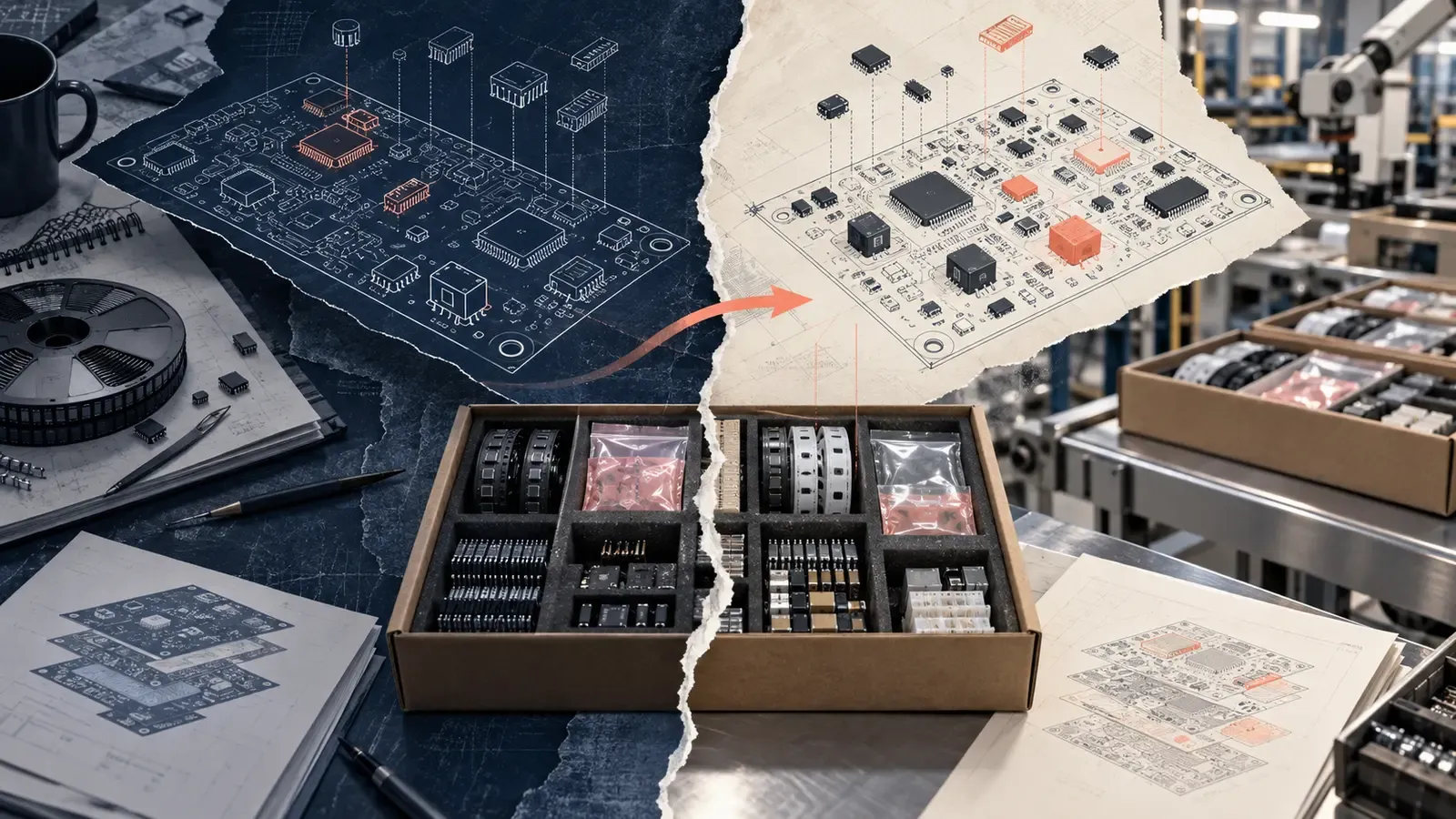
When a BOM changes after material has been kitted, the factory should not automatically build the newest revision or continue with the old one. It should apply a controlled effectivity decision to each affected job, lot or serial range. That decision must drive material disposition, WIP handling, machine programmes, work instructions, inspection criteria and customer communication.
An approved engineering change is only the beginning. The change becomes real when every execution record agrees on what should be built—and when the factory can prove how units already in motion were handled.
The change is approved, but the factory has already moved
An EMS programme rarely waits in a clean state for engineering. Purchase orders may be open, components may be in stock, kits may be staged, boards may be partly assembled and finished units may be awaiting shipment. Then an ECN changes a component, footprint, firmware, test limit or assembly instruction.
The document system can show the change as approved at 10:12. That timestamp does not answer the production question: which physical units should receive it?
If teams interpret “latest revision” differently, purchasing buys one definition, the warehouse kits another and production runs whichever programme is loaded. The risk is not merely administrative. It can create mixed configuration within one order and destroy the evidence needed for customer acceptance.
Effectivity is the operational boundary
Effectivity defines where the new rule begins. It may be based on date, work order, lot, serial number, shipment, site or a specific material-exhaustion condition.
A date alone is often too vague. Does the date refer to order creation, material issue, production start or shipment? What happens to a job released yesterday but starting tomorrow? A precise rule might say: “New capacitor applies to Work Order 4817 and subsequent orders at Site A, except Customer Programme Z until separate approval.”
That statement can be tested against actual transactions. It gives every function the same boundary.
Start with an affected-object assessment
Before implementation, identify everything touched by the change:
- product and BOM revisions;
- customer programmes and approvals;
- open quotations and sales orders;
- purchase orders and supplier schedules;
- stock, kits and line-side material;
- open jobs and WIP by operation;
- tooling, stencils, fixtures and feeders;
- machine and test programmes;
- work instructions and inspection plans;
- finished goods and shipments;
- service or warranty obligations.
The list converts an engineering decision into an operational plan. Without it, each department discovers the effect separately and at a different time.
Decide the disposition of existing material
The old component may be unusable, conditionally usable or fully acceptable for a defined population. The new component may require a different vendor, feeder, storage condition or inspection method.
Material disposition should be explicit:
- use existing stock until exhausted;
- return it to the supplier;
- rework or relabel it;
- reserve it for earlier revisions;
- scrap it;
- hold it pending customer approval.
The ERP record should connect the disposition to the change and affected inventory. A note in meeting minutes cannot reliably prevent an old reel from being issued three weeks later.
If the approved response is an alternate, the context described in The Alternate Part Is Approved. But for Which Customer? remains essential. Technical similarity does not replace programme-specific approval.
Kits need a controlled revalidation
Once material is staged, it often disappears from the planner’s normal shortage view. That makes post-kitting changes dangerous.
Every affected kit should be revalidated against the effective BOM. The system should identify additions, removals and substitutions, then create actionable warehouse transactions. Staff should not have to compare two large spreadsheets line by line.
The kit status should return from “ready” to “change review” until the difference is resolved. Only then should the job regain release status. This prevents the broader planning board from remaining green while the physical kit belongs to an earlier definition.
WIP requires unit-level decisions
For a job already in production, the correct action depends on where each unit is in the routing. Units before the affected operation may adopt the new change. Units after it may need rework, concession or completion to the earlier revision. Some changes require stopping the entire lot; others can be introduced at a controlled serial break.
The decision should produce a traceable relationship among the ECN, unit identity, operation and disposition. This becomes part of product genealogy. If a field failure occurs later, the company can identify which units carried which configuration.
Industry guidance on digital manufacturing describes the digital thread as including design revisions, engineering changes and manufacturing history. The practical value is exactly this: a physical product can be interpreted against the engineering rule that applied when it was built.
Programmes and instructions must move together
A BOM revision can be correct while production still executes the old process. Machine programmes, test scripts, visual aids and operator instructions may be stored in separate systems or local folders.
Change release should therefore include dependent-document checks. The job should reference approved versions rather than rely on an operator selecting the newest-looking filename. At line start, the system should confirm that the loaded programme and instruction version match the job’s effective configuration.
This is where engineering and MES integration matters. The execution layer should not merely record that a machine ran; it should retain which controlled recipe or programme ran for the unit.
Replanning is part of change control
The changed BOM can alter shortage position, lead time, setup duration, yield expectation and cost. Those effects belong in the production plan.
Suppose the new component is available but requires a feeder that is shared with another line. The material issue is solved, yet capacity changes. A new inspection step may add thirty minutes per lot. A customer approval hold may block one programme but leave another free to proceed.
The planning team should update readiness and sequence rather than preserve the original schedule for appearance. The pillar article, The Schedule Is Green. Why Is the Line Still Waiting?, explains why engineering status must be one of the live inputs to an executable plan.
Control the implementation meeting with evidence
A useful ECN implementation review should answer:
1. What changed and why?
2. Which products, customers, sites and orders are affected?
3. What is the exact effectivity rule?
4. What happens to purchased, stored, kitted and line-side material?
5. What happens to WIP and finished goods?
6. Which programmes, tools and documents must change?
7. Does capacity or delivery need replanning?
8. What evidence will confirm completion?
Each answer should point to a controlled record and owner. The meeting then coordinates execution instead of becoming the only place where the decision exists.
Measure implementation, not document approval
Engineering teams often measure ECN approval cycle time. Add operational measures:
- time from approval to affected-object assessment;
- number of open kits awaiting revalidation;
- WIP units without disposition;
- dependent programmes or instructions not yet released;
- schedule changes caused by the ECN;
- obsolete material value and disposition age;
- units produced after effectivity with the wrong configuration.
These measures expose the gap between approving a change and making the factory safe to execute it.
Change history should remain readable after implementation closes. Future engineers and quality teams need to understand not only the final revision, but also the transition population and the reasoning behind its disposition. That record supports warranty analysis, customer questions and future redesign. It also prevents a later team from repeating a temporary workaround without knowing the limits that originally made it acceptable.
Frequently asked questions
Should production always use the latest BOM revision?
No. Production should use the revision effective for the specific job, customer, site, lot or serial range. The newest revision may not yet apply to every open order.
What should happen to a kit after an ECN?
The kit should be revalidated against the effective BOM. Added, removed and substituted material must be resolved before the job returns to ready status.
How should WIP be handled during an engineering change?
Evaluate each unit or lot by its current operation and the change boundary. The controlled disposition may be use-as-is, rework, concession, hold or scrap.
Why is a document approval workflow insufficient?
Because the change also affects physical material, programmes, tooling, WIP, inspection, cost and delivery. Approval does not prove that those dependencies were updated.
What is the role of product genealogy?
Genealogy connects each unit to the configuration, material, processes and exceptions that applied. It allows the manufacturer to prove how the change was implemented.