
Your Service Team Works in the Field. How Do Parts, Labour and Status Get Back to Epicor?
Field service becomes difficult to control when dispatch, labour, parts, completion and billing facts remain outside Epicor or arrive late. The operating model should connect field execution back to the ERP record.
The short answer
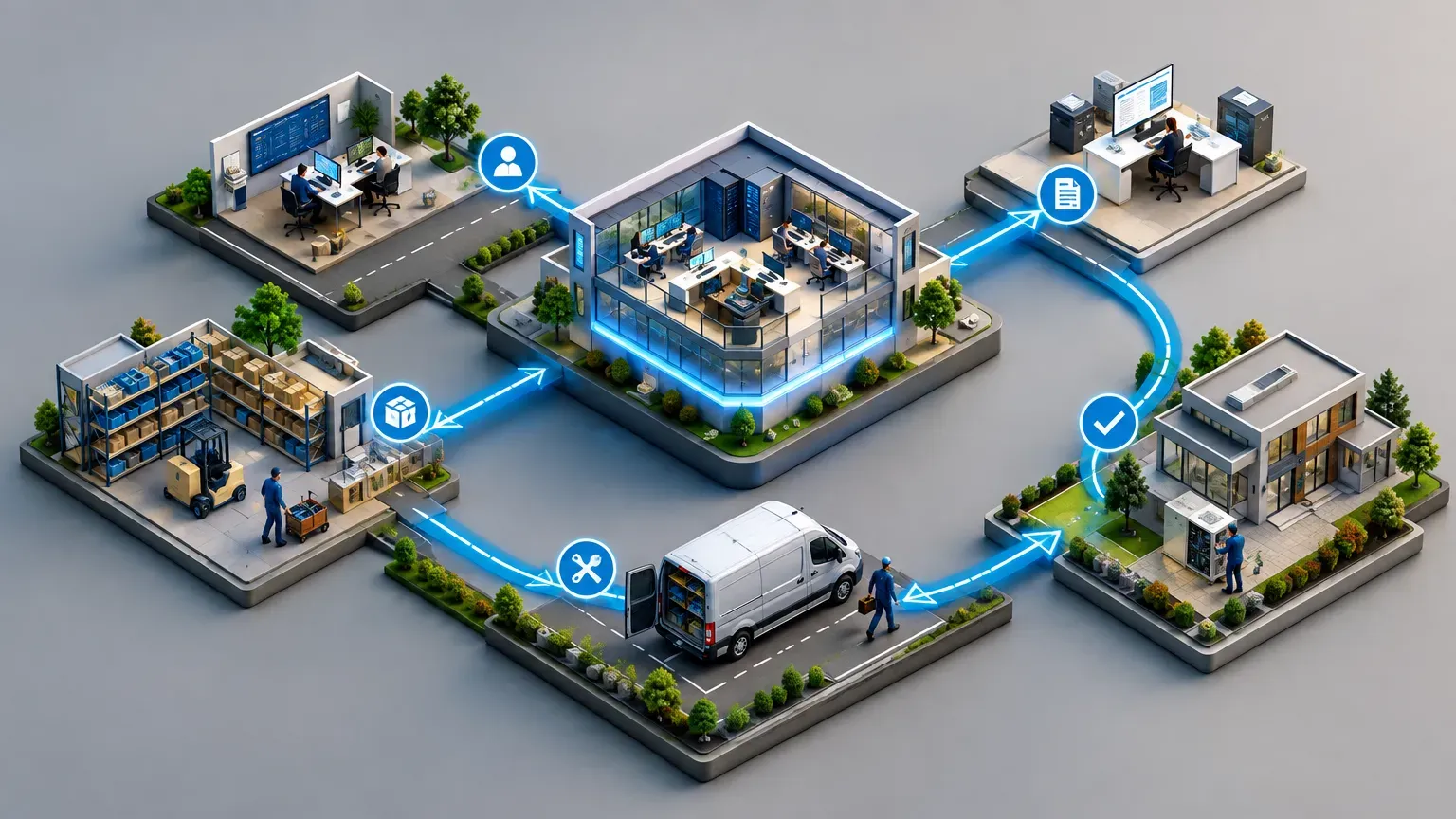
Field service should not become a separate operational world. Scheduling, technician activity, parts usage, labour, service completion and billing evidence may be captured through a mobile or specialist service experience, but the resulting business facts should return to the controlled Epicor environment quickly enough to support inventory, costing, customer history and finance.
The management challenge is to connect the remote work without forcing technicians to behave like back-office ERP users.
How this connects to the pillar
The architecture principle comes from Where Should Epicor Stop—and Where Should Connected Operational Apps Begin?: specialized execution can sit outside the standard ERP interface while authoritative business consequences remain connected to Epicor.
Field work creates an information gap
A service job can be physically complete long before the enterprise record catches up.
The technician may know the machine is running again. Parts may already have been consumed. Labour has already been spent. The customer may have signed the work record.
If those events sit in notes, messages or a disconnected service application until later entry, inventory and financial records lag behind reality.
Define the service transaction chain
Start by mapping the business events rather than the screens.
A typical chain may include:
- service request;
- scheduling and dispatch;
- technician acceptance;
- travel or attendance;
- diagnosis;
- part issue or consumption;
- labour capture;
- status change;
- completion evidence;
- customer confirmation;
- billing readiness.
Not every business uses the same sequence, but each event should have a clear owner and destination.
Keep parts usage tied to inventory truth
Field inventory is easy to lose control of because it moves outside the warehouse.
A technician may carry van stock, receive parts directly at site or transfer material between service locations. If the operational application records consumption without returning the inventory consequence correctly, the ERP balance becomes theoretical.
A connected process should make the physical part event and the Epicor inventory event part of the same workflow.
Capture labour while context still exists
Service labour is difficult to reconstruct accurately after the day ends.
Technicians may remember the total duration but not the boundary between travel, diagnosis, repair and waiting. The correct level of detail depends on the business, but the capture point should support the cost and performance questions management actually asks.
The mobile experience should make timely entry easier than later reconstruction.
Separate technician experience from accounting consequence
Technicians should not need to understand every financial field created by their work.
The field workflow can capture operational facts in language that fits the job. Controlled rules can then translate those facts into the structures required by costing, service history and billing.
This separation is valuable because it keeps the interface practical without hiding the business consequence.
Design offline behavior deliberately
Field work often occurs where network quality is uncertain.
If the application supports offline work, define which actions can be safely stored and synchronized later. Consider duplicate prevention, conflict handling and the visibility of unsynchronized work.
The technician should know whether a transaction is complete in the enterprise system or merely saved locally.
Make status meaningful to the next team
A service status should exist because another decision depends on it.
“Technician dispatched,” “waiting for part,” “work complete” and “ready to invoice” may matter to different functions. If statuses are too vague or updated late, customer service, planning and finance create parallel tracking.
A controlled service model defines the operational meaning and the trigger for each significant status.
Connect evidence without turning the ERP into a document dump
Photos, signatures, checklists and notes may be valuable service evidence.
The design should distinguish evidence that needs to be retained from data that needs to become a structured business fact. A photo can support a completion record, but it does not replace a controlled part transaction or labour entry.
This keeps the ERP record useful for reporting while still preserving service context.
What management should measure
Useful indicators include:
- delay from physical completion to ERP completion;
- unposted field parts usage;
- labour entered after the service day;
- jobs completed operationally but not ready for billing;
- offline transactions awaiting synchronization;
- service status age;
- manual reconciliation between service and ERP records.
These measures reveal whether field execution is connected to the enterprise operating model.
ACC context
ACC’s Epicor experience includes connecting operational workflows back to the ERP foundation so remote or mobile work does not become a separate source of business truth. The principle is the same across warehouse and service environments: simplify execution while preserving authoritative records. Explore ACC’s Epicor capabilities.
Operational review point
Select one recently completed service job and reconstruct the timeline from dispatch through billing readiness.
Compare the physical events with the timestamps in the enterprise systems. Identify every delay, re-keying point and reconciliation step. Then ask which delays are legitimate controls and which exist only because the execution and ERP experiences are disconnected.
That single-job review often exposes more useful improvement opportunities than a feature checklist.
Treat van stock as a controlled warehouse problem
Technician inventory is still inventory even when it sits in a vehicle.
The operating model should define how stock reaches the technician, how ownership and location are represented, how returns are handled and what happens when a part is consumed without connectivity. If van stock is managed informally, the service application may appear efficient while the enterprise inventory record drifts.
The same principles used in warehouse execution apply: physical movement, identification and the authoritative transaction should stay close together.
Connect service completion to commercial readiness
A completed repair is not always a commercially complete service job.
Billing may still depend on signed evidence, parts confirmation, labour classification, contract coverage or customer approval. If those elements are collected in different tools, finance may wait even though the technician considers the work finished.
A connected design makes the handoff from operational completion to billing readiness explicit.
That reduces the hidden queue of “finished but not ready” work.
Use service history as operational evidence
A useful service history is more than a record of visits.
It should help the next technician or service manager understand what was done, which parts were used, what condition was observed and whether the issue is recurring.
Structured status and transaction data can support this interpretation far better than isolated free-text notes.
The objective is not to capture more documentation. It is to preserve enough operational evidence that future service decisions do not depend on one technician remembering the previous visit.
Make customer communication depend on controlled status
Service customers often ask a simple question: what is happening with my job?
If dispatchers, technicians and back-office teams maintain separate status views, the answer can depend on who is asked. A connected workflow should provide a small number of statuses with clear operating meaning so customer communication reflects the same evidence used internally.
That does not require exposing every internal step. It requires confidence that a customer-facing update is derived from controlled service progress rather than a parallel note.
Link recurring service issues back to product decisions
Service data becomes strategically useful when recurring field evidence can be connected to products, assets, parts and operating history.
Repeated failures, repeated part replacement or unusually high labour effort can become signals for engineering, warranty or product-management review. That insight is weaker when service records live outside the enterprise data model.
The objective is not to turn every technician note into analytics. It is to make important recurring patterns traceable to controlled product and service records.
Reconcile service exceptions by cause
When service transactions fail to reach Epicor, do not treat every case as a generic synchronization issue. Separate missing master data, invalid status, unavailable stock, incomplete evidence and technical communication failure. Different causes need different owners. Categorizing them also shows whether the real improvement belongs in field workflow, data governance or integration reliability.
Frequently asked questions
Should technicians work directly in the full ERP interface?
Not necessarily. A focused service experience may be more appropriate if it returns controlled business facts to Epicor.
How should field parts be controlled?
Define locations, ownership and transaction rules so consumption and movement update the authoritative inventory record.
Is offline service capture safe?
It can be, but synchronization, duplicate prevention, conflict handling and user visibility need deliberate design.
What service status matters most?
The useful statuses are those that trigger a real next decision such as dispatch, parts action, customer communication or billing.