

Production Is Complete. Why Can Packing Assortment Still Delay Shipment?
Finished garments are not automatically shipment-ready: color-size ratios, carton assortment, labeling and buyer packing rules can still stop dispatch.
The short answer
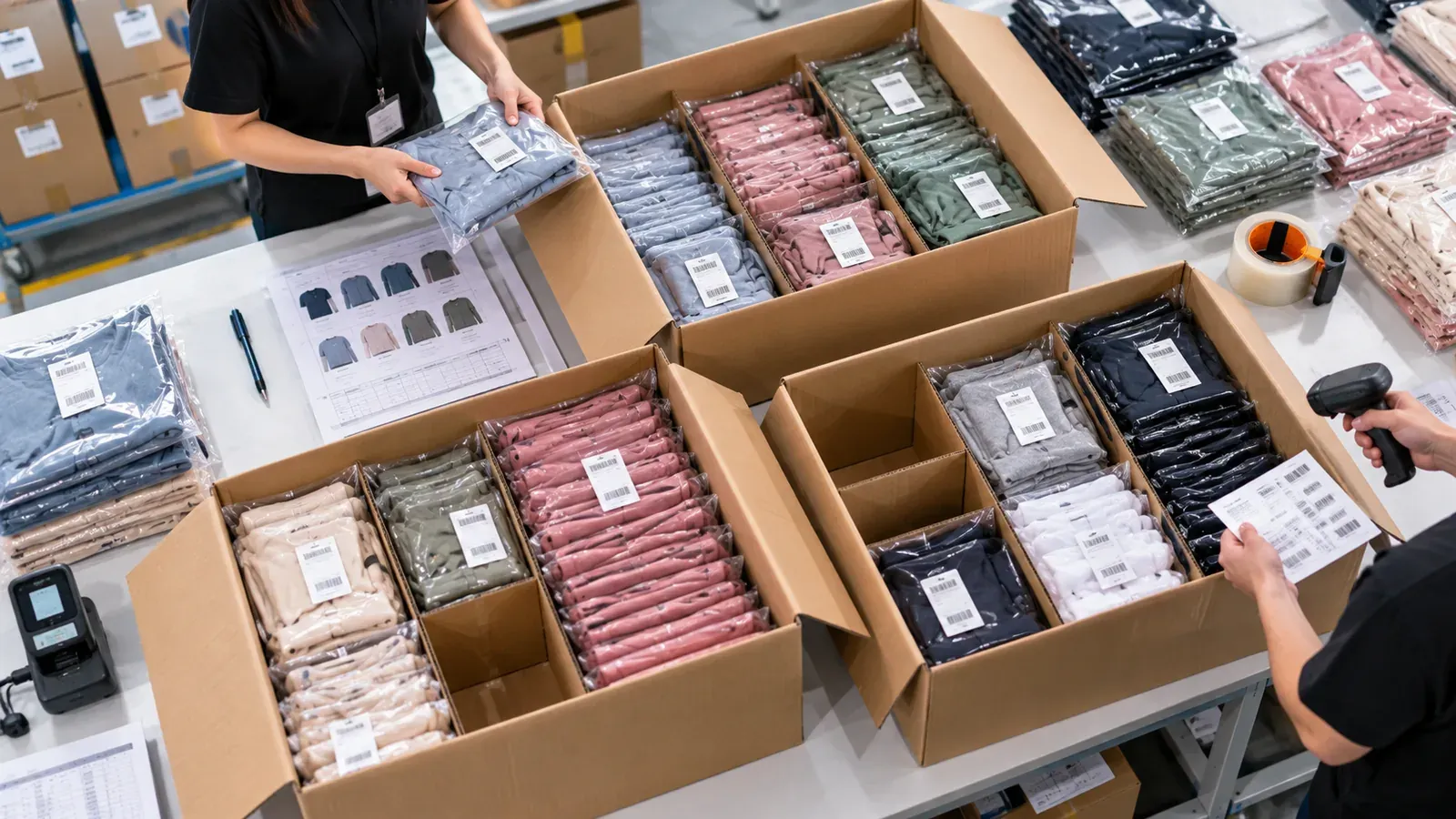
Because shipment readiness is not the same as sewing completion. A buyer may require specific color-size ratios per carton, store allocations, barcode labels, folding methods, polybags, carton markings or mixed-size assortments. If the finished goods cannot be assembled into the required packing structure, the order can remain commercially unshippable even when total production quantity looks complete.
The control point is therefore the transformation from finished pieces into shipment-valid cartons.
This is one of the late-stage risks inside delivery exception control across open garment orders: production can be complete while the shipment is still not ready.
The total can be complete while the shipment mix is still wrong
Imagine an order for 10,000 pieces. Production reports 10,020 completed. It sounds safe.
But the buyer requires cartons built in a fixed ratio across S, M, L and XL. If XL is short, many cartons cannot be closed even though total quantity exceeds the order.
The same problem appears with colors, destination allocations and store packs.
This is why the color-size matrix must remain visible beyond production. It is not only a planning structure. It can determine whether the warehouse can create the required shipping units.
Packing is part of production, not an afterthought after sewing.
Packing is often treated as logistics administration. Operationally it is another controlled production step.
Inputs include finished garments, approved labels, hangtags, polybags, cartons, barcode data and buyer instructions. The process transforms those inputs into a shipment unit with a defined identity and quantity.
That means packing needs:
- work instructions;
- material readiness;
- quality checks;
- traceable completion;
- exception handling.
If packing is managed outside the main order flow, the company can discover problems only after sewing appears complete.
Buyer-specific packing rules create operational complexity late in the order.
Different buyers may require different:
- folding methods;
- polybag warnings;
- price tickets;
- hanger types;
- carton quantities;
- carton labels;
- RFID or barcode identifiers;
- destination sorting;
- assortment ratios.
The more buyers and markets a factory serves, the more dangerous it becomes to rely on tribal knowledge.
A packing rule should be attached to the order and effective version, not kept in a separate folder that warehouse teams interpret manually.
Assortment planning is only as good as the colour-size completion picture
Packing planners need to know not merely what production planned to finish, but what is actually available and released.
Suppose the line reports 500 pieces of Medium complete. If 30 are in quality hold and 20 are in rework, only 450 may be packable. Using reported output rather than released quantity causes false readiness.
This is where integration with shopfloor/MES and quality status becomes important. The packing team should consume a qualified quantity.
Traceability matters when finished goods become shipment units.
industry guidance traceability principles distinguish events such as packing, shipping and receiving, along with the key data that describes those events. That distinction is useful in apparel because a piece being produced, packed and shipped are not the same event.
When packing creates a carton, the business should know what order/style/color-size content is inside, how it is identified, and what shipment it belongs to.
The goal is not bureaucracy. It is confidence that the physical box matches the digital promise.
The most dangerous packing exception is the one that still looks like finished production.
Useful exceptions include:
- ratio cannot be completed;
- one color/size remains in quality hold;
- buyer label or barcode data missing;
- carton specification not approved;
- insufficient packing material;
- wrong destination allocation;
- carton count inconsistent with booking;
- packed quantity exceeds or falls short of shipment plan.
Each should be related to the shipment consequence.
A shortage of five pieces may be trivial if cartons can be rebalanced. The same shortage may be critical if it prevents 40 fixed-assortment cartons from closing.
Where Epicor Venus connects finished garments with shipment-ready assortments
Epicor provides the enterprise-grade ERP foundation for inventory, orders, purchasing, finance and governance. Epicor Venus adds garment-specific colour-size, packing, order and production context, helping the business connect what the factory finished with what the buyer actually expects to receive.
That is important because assortment, labelling and packing exceptions often appear after the factory believes the order is complete. ACC works with manufacturers to keep those final conditions inside the same order flow so shipment risk becomes visible before the logistics window closes. Explore Epicor Venus for garment and apparel manufacturing.
Shipment readiness needs a stricter definition than production complete
A shipment should be called packing-ready only when:
- released finished-goods quantity is available by required color/size;
- packing materials are available and approved;
- current buyer packing instruction is effective;
- barcode/RFID/label data is ready;
- destination/assortment structure is known;
- quality holds affecting the shipment are visible.
This definition is much stronger than “production complete.”
The delay clock should start where the shipment actually becomes blocked.
When packing is late, avoid recording only “warehouse delay.”
Find the actual cause. Was the missing size produced late? Was buyer artwork late? Was the carton rule changed? Was quality release incomplete? Was barcode data missing?
Otherwise the organization blames the final department for problems created upstream.
Exception analytics should preserve that causal chain.
Assortment control works when packing sees the true order mix early
Packing should begin from a defined shipment structure rather than from a pile of finished garments. The warehouse needs the final color-size ratio, destination split, carton quantity rule, label requirement and any buyer-specific packing instruction before it can build valid shipping units. When those inputs remain fluid, early packing can create rework even though production appears complete.
The key quantity is packable quantity, not total finished quantity. Units in quality hold or rework cannot support a carton until they are released. Overproduction in one size cannot compensate for a shortage in another if the buyer requires a fixed ratio. The packing view should therefore reconcile released color-size quantities with the exact assortment needed by each shipment.
Shipment splits make this even more important. If one order feeds several destinations or delivery dates, the first packing wave can consume the sizes needed for a later shipment. Reservation by shipment or destination protects the required mix and prevents one successful dispatch from causing the next exception.
A useful packing exception identifies the exact cartons or destinations affected, the missing quantity and the upstream cause. If one size is short because of rework, the issue should remain linked to quality and production rather than being converted into a generic warehouse delay. That continuity lets the right team recover the problem while allowing unaffected cartons to move forward where possible.
The last production percentage can carry disproportionate shipment risk.
For Production Is Complete. Why Can Packing Assortment Still Delay Shipment?, the final check is whether the current issue has a clear owner, a latest safe action time and an explicit downstream condition that proves recovery. That prevents the article's control logic from stopping at status reporting and keeps attention on the decision that can still change the result.
Packing completion and shipment release are different milestones.
A carton can be physically closed and still not be ready for shipment. The order may require a final count reconciliation, destination assignment, buyer-specific label confirmation or release from quality. Keeping a separate shipment-release status prevents the warehouse from treating physical packing as the end of the control process.
This distinction also helps when one order is split. Some cartons may be complete and releasable while others remain blocked by a shortage. The system should allow that difference to remain visible instead of forcing the whole order into one broad status. That gives the business more flexibility to protect the ready portion where the commercial plan allows it.
Finally, the packing team should record the reason an assortment could not be completed. Repeated shortages in the same size, destination or packing component can reveal upstream planning problems. Without that cause, the warehouse becomes the apparent source of delay even when the real issue began earlier in production, quality or buyer instruction.
The final control is whether the packed order matches the buyer promise
Before the warehouse closes the shipment, it should reconcile the actual released assortment against the planned carton structure one final time. This catches small color-size gaps before they become a loading problem and gives the team a clear basis for deciding whether unaffected cartons can move while the shortage is recovered.
FAQ
If total quantity is complete, why not ship loose and fix the ratio later?
Because buyer/store requirements often define the accepted shipping unit. Changing assortment may require approval and can create downstream receiving problems.
Does packing need MES-level tracking?
Not always at the same granularity as sewing, but the process should record meaningful completion and exceptions against cartons/shipments.
Are barcodes mainly a warehouse issue?
No. Barcode content can depend on product, buyer, destination, price, size and shipment data created earlier in the order lifecycle.
Can a color-size shortage block only part of the shipment?
Yes. A connected system should show which cartons or destinations are affected so unaffected quantities can be considered for release where commercially acceptable.