

Fabric Is Ready. Why Can One Missing Trim Still Hold the Whole Order?
A garment order can look materially ready while one zipper, label, elastic or approved accessory quietly prevents cutting, sewing or packing from starting on time.
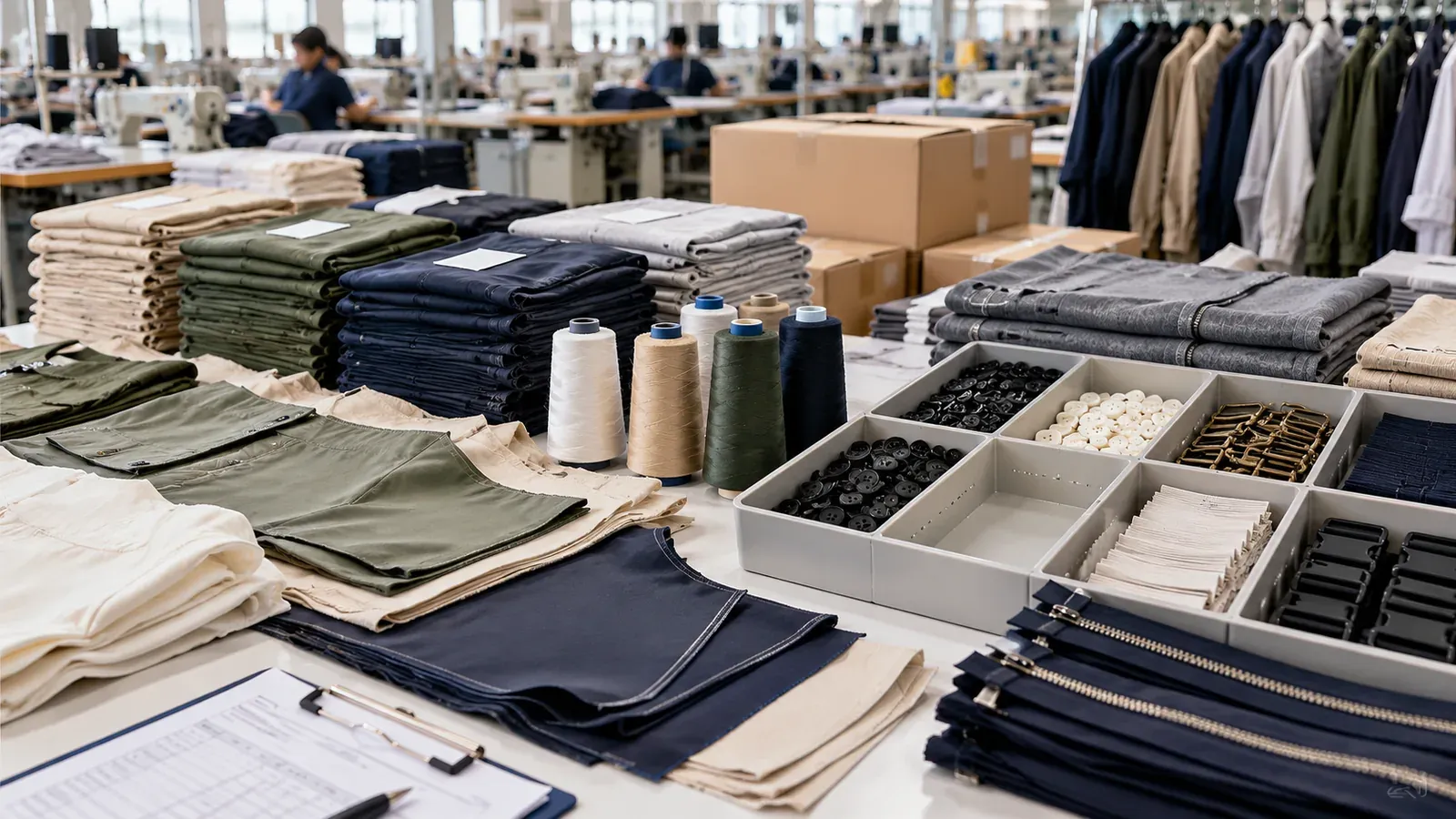
The short answer
Because garment production readiness is constrained by the last critical component, not by the largest material category. Fabric can be inspected, allocated and sitting beside the cutting table while one missing zipper, button, label, elastic, drawcord, heat transfer or buyer-approved accessory still prevents a style from starting, finishing or packing correctly.
The operational mistake is to ask, “Is the fabric ready?” when the real question is, “Is the order ready for the next irreversible step?” That requires a component-level view of what gates cutting, sewing, finishing and packing.
This issue sits inside the wider question of delivery exception control across open garment orders: which small unresolved condition can still break the promised date?
A tiny component can carry the entire delivery risk
Trims are often low-value compared with fabric, but they can have high schedule leverage. One missing trim may affect every garment in a style or one color-size branch of the order. The purchase value can be small while the delivery consequence is large.
That asymmetry creates false confidence. Managers see most of the material value in-house and assume the order is safe. Production sees a specific component shortage and knows the line cannot complete. Both statements can be true.
A useful readiness model therefore needs to distinguish financial material value from operational gating value.
“Available” can mean very different things to warehouse, planning and production.
A trim can be available in the purchasing system and still not be usable.
It may be physically received but not inspected. It may be in the warehouse but reserved for another order. The quantity may be enough in total but short for one color. The component may be correct but buyer approval is still pending. The substitute may be accepted commercially but not reflected in the production specification.
Treating all of those states as “on hand” collapses important distinctions.
For garment execution, teams need a progression such as:
requested → ordered → supplier confirmed → received → inspected → approved → allocated → issued.
The exact labels can vary. The principle is that the next production step should consume a meaningful readiness status rather than a purchasing status.
The factory needs order readiness, not only inventory visibility
Inventory tells you what exists. Order readiness tells you whether the required combination exists for the work that must happen next.
Suppose a jacket needs shell fabric, lining, zipper, snap, label and polybag. Five components are complete. The sixth is short. At warehouse level the material situation may look healthy. At order level the style is not ready.
A garment-specific system should therefore roll component positions into an order/operation consequence. Epicor Venus publicly describes fabric and trim planning, multidimensional BOM handling and integrated production control. The useful operational outcome is not simply a detailed BOM. It is the ability to connect the BOM position to the order and the production decision.
Partial readiness is useful only when the factory knows what can safely start.
Not every shortage should stop all work.
If the missing item is used only in finishing, cutting and early sewing may still start safely. If the missing item affects a construction operation near the beginning of the route, starting may create stranded WIP. If only one color is short, another color may proceed.
This is where blanket “ready / not ready” logic becomes too crude.
Teams should classify components by gate point:
- required before cutting;
- required before line start;
- required before a specific sewing operation;
- required before finishing;
- required before packing.
Then the system can support a more intelligent decision. The objective is not to wait for perfection. It is to avoid creating WIP that cannot progress.
One missing trim can trigger a chain of secondary disruption
A missing trim rarely stays isolated.
Planning may move the style to another date. That change can displace another order. Purchasing may expedite air freight. Finance sees extra cost. Merchandising may ask the buyer for a substitute. Production may split colors. Warehouse may hold already prepared kits.
If those actions happen in separate tools, the company can spend more time coordinating the response than solving the shortage.
This is why exception ownership matters. The shortage record should show the affected order, required date, next gated operation, approved recovery path and owner.
The important signal is whether one small item is now controlling the order.
Management does not need a list of every late purchase order. It needs the trim shortages that threaten buyer commitment.
A practical exception view can rank shortages by:
1. days/hours to the gated operation;
2. affected order value or strategic importance;
3. percentage of order blocked;
4. substitute availability;
5. supplier recovery confidence;
6. downstream shipment consequence.
This converts purchasing detail into delivery risk.
Repeated trim crises are usually evidence of an upstream pattern.
Recurring shortages often point to master-data or planning weaknesses rather than bad luck.
Check whether lead times reflect reality. Check whether consumption is maintained by color/size where required. Check whether minimum order quantities and pack sizes distort purchase quantity. Check whether buyer-specific labels are released late. Check whether substitutes are structured and approved rather than handled informally.
The purpose of exception analysis is not only to firefight the current order. It should reveal which trim families repeatedly create risk.
Where Epicor Venus connects trim status with the order that depends on it
Epicor provides the enterprise-grade ERP foundation for purchasing, inventory, supplier commitments and finance. Epicor Venus adds the garment-specific BOM, colour-size, order, material and production context needed to show whether a trim is merely in stock or genuinely ready for the quantity and operation that needs it.
ACC helps manufacturers design that readiness logic so a small missing component becomes visible before it stops a high-value order. The benefit is not more inventory reporting; it is earlier intervention around the exact delivery commitment at risk. Explore Epicor Venus for garment and apparel manufacturing.
Trim readiness should become stricter as first use approaches
Before a style enters production, ask:
Are all components required before the next irreversible operation physically available, quality-approved, allocated to this order and reflected in the current specification?
If the answer is no, the order is not fully ready—even if fabric availability is 100%.
That definition is stricter, but it is also much closer to how garment factories actually operate.
The strongest control keeps the missing accessory connected to the delivery consequence.
Trim readiness should be evaluated against the first operation that needs the component. A zipper required at an early sewing step has a different latest-safe-arrival time from a hangtag used during packing. That means the planning system should connect each critical trim to the production gate it can block, rather than treating every shortage as the same type of late purchase.
The order should also distinguish physical stock from usable stock. A component may be received but still waiting for inspection, approval or allocation. Another batch may be in the warehouse but reserved for a different order. The readiness calculation therefore needs the approved quantity actually available to the affected order, not only the warehouse balance.
Partial readiness deserves a rule as well. If one color is short but the other colors are complete, the factory may be able to start safely. If the missing trim is required near the beginning of the route, starting can create stranded WIP and extra handling. The decision should reflect where the component sits in the process and whether downstream work can continue without rework or congestion.
Repeated shortages should become improvement data. Review which trim families create the most disruption, how often the root cause is buyer approval, inaccurate lead time, supplier performance, consumption error or late release. The goal is to reduce the number of emergencies at source. Better visibility is useful, but the larger gain comes when the same shortage pattern stops recurring.
The cheapest trim problem is the one found before it becomes a line problem
For Fabric Is Ready. Why Can One Missing Trim Still Hold the Whole Order?, the final check is whether the current issue has a clear owner, a latest safe action time and an explicit downstream condition that proves recovery. That prevents the article's control logic from stopping at status reporting and keeps attention on the decision that can still change the result.
FAQ
Should factories wait for every trim before cutting?
Not always. The decision should depend on where the trim is used and whether starting work creates stranded WIP or rework risk.
Can total inventory hide a color-specific shortage?
Yes. A material can be sufficient in aggregate while one color, finish or size-related component remains short for the exact order mix.
Why link trim readiness to the delivery date?
Because the same shortage has different urgency depending on the next operation and remaining recovery time.
Is trim planning mainly a purchasing problem?
No. Purchasing is only one part. Buyer approval, BOM accuracy, allocation, inspection, production sequencing and substitution decisions all affect readiness.