

Inside the Invisible Factory: Where Garment Orders Lose Time, Margin and Control
A garment order can look healthy in a spreadsheet while delays, excess cost and conflicting decisions accumulate between merchandising, materials, production and finance.
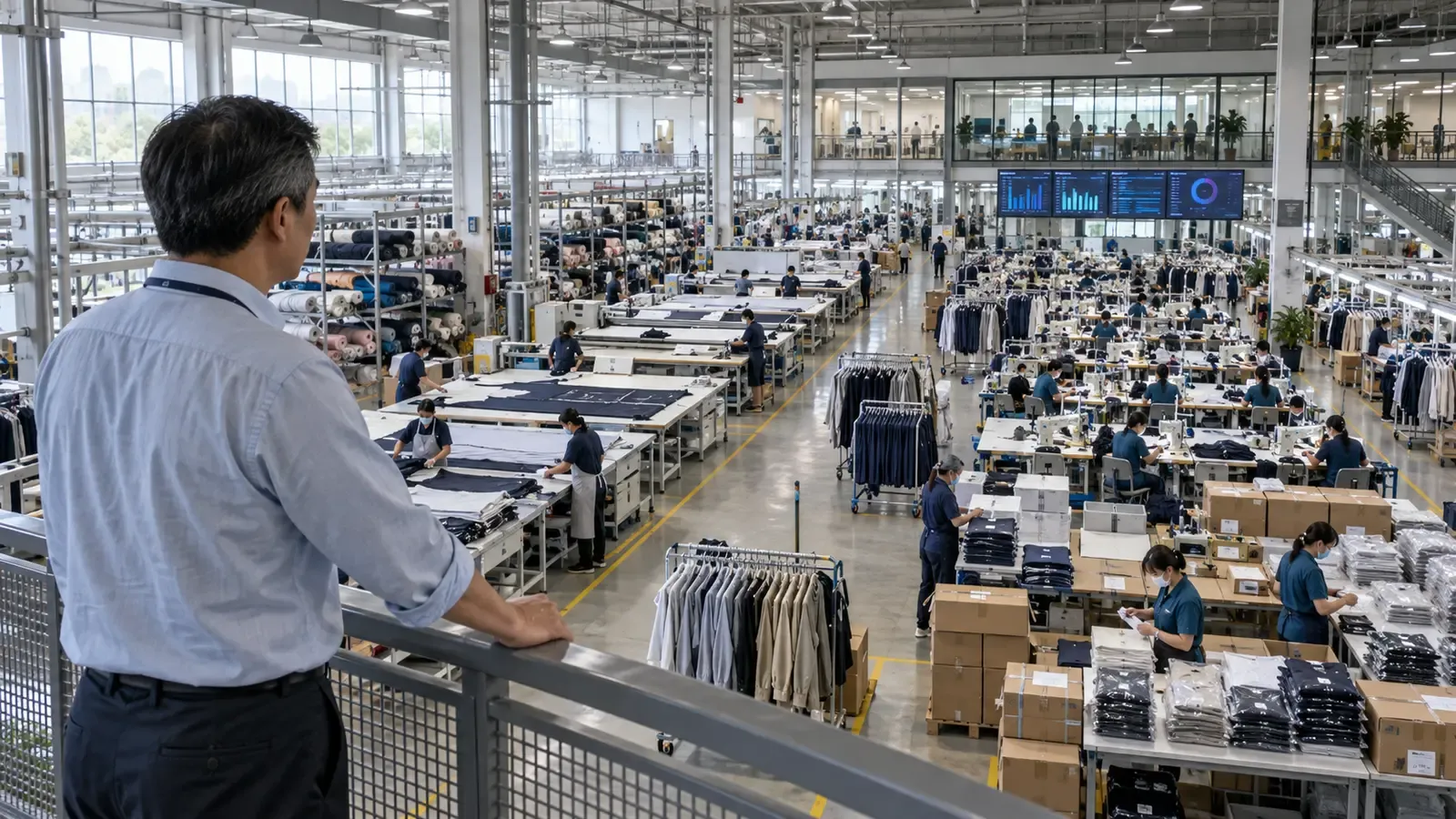
At 8:47 on Monday morning, the order still looks healthy. The merchandiser’s sheet says fabric has arrived. The planning board says sewing starts Wednesday. Finance is carrying the margin agreed six weeks ago. The factory has marked the style green.
Yet the fabric is divided across shade lots, the approved colour has changed, one trim is waiting for inspection, and the line that was meant to take the order is finishing another buyer’s rush programme. Every statement is technically true. Together, they describe a delivery that may already be late.
This is the invisible factory: not the building full of machines, but the network of decisions between sample room, merchandising, sourcing, warehouse, cutting, sewing, quality, shipping and finance. Garment orders lose time and margin inside that network when each team sees only its own version of the order.
The short answer
Garment orders most often lose control at handoffs. A buyer revision changes quantities or construction; material demand does not update everywhere; inventory is present but not usable; a production status hides queues and rework; actual costs arrive after the commercial decision. The remedy is not another summary spreadsheet. It is a shared operational record that connects the style, colour-size breakdown, bill of materials, material allocation, factory plan, shop-floor progress and cost history.
That is the role of garment ERP and connected manufacturing execution: to make the order’s current truth visible while there is still time to act.
Follow one order, not seven departments
An apparel order begins as a commercial promise, but it quickly becomes several operating objects. There is a style specification, an assortment, a bill of materials, purchase commitments, factory capacity, work orders, inspections, cartons, invoices and eventually an explanation of margin.
The order is therefore less like a baton passed neatly along a track and more like a live network. A change at one point should alter the relevant decisions elsewhere. If the buyer adds a colour, material requirements change. If usable width is lower, consumption and cutting plans change. If a factory allocation moves, capacity, logistics and cost assumptions may change.
Disconnected operations turn these dependencies into manual messages. People become the integration layer. They copy, reconcile and chase—and because the work is invisible, management often mistakes heroic coordination for a reliable process.
Six places where the order disappears
1. The commercial version outruns the operating version
The buyer and merchandiser may agree a revision by email while purchasing, production and costing continue from an earlier file. A colour name that looks harmless can represent a different material, lead time or minimum quantity. The problem is explored in One Shade of Blue, Three Versions of the Truth: revision control is not clerical hygiene; it is production control.
2. Margin is frozen while reality keeps moving
The first cost sheet wins the order, but it does not necessarily describe the order that gets made. Fabric yield, airfreight, overtime, rework and changed quantities accumulate after approval. The Bestseller That Quietly Loses Money follows the gap between an attractive sales result and disappointing contribution.
3. Stock is counted without asking whether it can be used
A warehouse balance can include fabric reserved for another order, an unapproved shade lot or material still under inspection. Availability must be specific to the requirement and date. The Fabric Is in the Warehouse. So Why Can’t Cutting Start? shows why “in stock” is not the same as “ready to cut.”
4. Factory status compresses away the risk
Two sites can both report “on schedule” even when one has stable throughput and the other is relying on tomorrow’s overtime. The label reports confidence, not evidence. When Two Factories Both Say ‘On Schedule’ proposes a more comparable operating language.
5. Meetings reconstruct the past
When supervisors spend the first hour collecting yesterday’s output, work-in-progress and defect numbers, the meeting starts with reconciliation instead of action. The 9 A.M. Production Meeting a Connected Factory Shouldn’t Need asks what becomes possible when status is already visible.
6. Traceability begins only after escalation
A buyer asks which material lot entered a shipment. The answer may exist across receiving records, cut tickets, production bundles and inspection files, but nobody can assemble it quickly. Can You Trace This Order Before the Buyer Calls? treats traceability as everyday operational design rather than emergency archaeology.
A practical operating model: promise, requirement, readiness, flow, result
The invisible factory becomes manageable when leaders review five connected layers.
1. Promise: What exactly has been agreed—style, assortment, quality, quantity, price and delivery?
2. Requirement: What materials, operations and capacity does the current promise require?
3. Readiness: Are the correct materials, approvals, tools and production resources available for the relevant date?
4. Flow: Where is work now, what is blocking it, and is progress sufficient for the remaining time?
5. Result: What shipped, at what quality and actual economic outcome?
The strength is in the connections. A new promise recalculates requirements. Readiness constrains the plan. Flow updates delivery risk. The result improves the next quotation and allocation decision.
What connected garment operations look like
ACC describes Venus as an ERP platform for apparel and garment manufacturing, spanning functions including sample management, order tracking, multidimensional bills of materials, colour-size matrices, fabric and trim planning, cut-order optimisation, garment costing, production visibility and multi-factory planning. Those capabilities matter when they operate as one decision system rather than isolated modules. See the official Venus overview for the current product scope.
A useful implementation does not attempt to digitise every habit at once. It identifies the few events that change downstream work: order confirmation, revision approval, material allocation, inspection release, cut release, line input, quality hold and shipment. Each event needs an owner, a timestamp and consequences that become visible to the next decision-maker.
The false comfort of a single dashboard
Executives often ask for one dashboard, understandably. They want a compact answer to a complicated business. The danger is that a summary can preserve the same fragmentation in a more attractive form. If every department uploads a number from its own process, the colours may align while the underlying order identities, cut-offs and definitions do not.
A credible management view must be able to explain itself. A delivery-risk indicator should open into the material, capacity or quality condition behind it. A margin forecast should point to the revision, consumption or execution event that changed it. A factory status should reveal the quantities and time assumptions on which it depends.
This is the difference between reporting integration and operational integration. Reporting integration collects conclusions. Operational integration connects the events from which conclusions are made.
A 30-day discovery exercise
Before selecting a transformation scope, follow a small number of live orders for one month. Include a straightforward repeat order, a new style, a revised order and an order divided across factories. Do not begin with a catalogue of software features. Record where people wait, copy, reinterpret, reconcile or ask for confirmation.
For every interruption, note four things: the decision being made, the evidence required, where that evidence originates and what happens downstream when it changes. The exercise usually reveals a smaller set of high-leverage connections than a department-by-department requirements list.
Then rank the gaps by operational consequence. A duplicated description is inconvenient; a revision that fails to change purchasing is expensive. A daily report prepared manually is inefficient; a quality hold that cannot block shipment is dangerous. Prioritisation should follow consequence, frequency and recoverability.
The human side of shared truth
Connected records change authority as well as information. A planner can no longer quietly protect a fragile date with a private buffer. A merchandiser’s revision becomes visible to costing and materials. A factory’s recovery plan can be tested against capacity. That transparency may feel threatening if leaders treat every exception as failure.
The operating culture must distinguish early warning from poor performance. People should be rewarded for exposing a constraint while options remain. The system should make ownership clear without turning visibility into surveillance. Otherwise, teams will continue to manage the real order in private channels and update the official record only when the story is safe.
The most reliable factories are not those with no exceptions. They are those in which an exception travels quickly to the people who can resolve its consequence.
Questions leaders should ask on the factory walk
From pilot order to operating discipline
A pilot should prove a management loop, not only a technical connection. Choose orders with enough variation to expose real handoffs, then define the result in operational terms: fewer unresolved revision mismatches, earlier material warnings, less time reconstructing production status, faster trace retrieval and a more current view of expected margin.
Begin with identity. The order, style, colour-size combination, material, factory and production work need controlled references. Next establish events and responsibility. Who approves the revision? What makes material cuttable? When is output counted as accepted? What event changes delivery risk? Finally, design the exception route: who is notified, what decision is expected and how closure is confirmed.
Do not hide imperfect data during the pilot. Make uncertainty visible. An unknown inspection status should appear as unknown, not available. A production figure reported at yesterday’s cut-off should carry that time. Honest limitations create better decisions than precise-looking estimates whose origin has disappeared.
After the first cycle, review which manual work vanished and which merely moved. A new spreadsheet exported from the system may preserve the old reconciliation habit. A new dashboard that depends on supervisors retyping totals may improve presentation without improving flow. The test is whether the order’s event updates the next decision naturally.
What the board should expect
For senior leadership, connected garment operations should produce business evidence rather than an implementation vocabulary. Look for lead-time variability, avoidable premium freight, material ageing and excess, forecast accuracy, recovery dependence, quality response time and the gap between quoted and actual contribution.
No single measure proves transformation. A factory could reduce inventory by accepting more delivery risk, or improve output by building excess work-in-progress. Read measures as a system. The purpose is to improve the reliability of promises while protecting quality, cash and margin.
The board should also ask how knowledge survives people. Apparel operations will always depend on expertise, relationships and judgement. Connected processes do not replace those assets; they prevent essential facts and decisions from existing only in personal files or memory.
The final standard is straightforward: can the organisation explain the current state of an important order, the evidence behind that state, the next risk and the owner of the next decision? If that answer is fast and consistent across functions, the invisible factory is becoming visible.
A note on technology choices
The architecture should follow the operating model. Evaluate whether a platform understands apparel variants, changing bills of materials, material lots, allocations, production events, multi-site responsibility and style economics as connected objects. Test the difficult cases: partial deliveries, late assortment changes, substitutions, rework, transfers and corrections.
Integration also needs ownership. Decide which system creates each core identity, how updates travel, what happens when a message fails and how users see the last successful update. A silent interface failure can create a more dangerous version conflict because teams assume automation has removed the need to check.
Finally, require usable history. Management needs current truth, but improvement and accountability require knowing how that truth changed. Effective dates, approvals and corrections should remain explainable without forcing ordinary users to become database specialists.
The technology succeeds when that discipline feels like normal work rather than a separate reporting exercise performed after the real decisions.
- Can a merchandiser show which revision production is using without opening email?
- Can the warehouse distinguish physical, allocated, inspected and cuttable stock?
- Can planning explain “on schedule” with remaining quantity, rate and time?
- Can finance compare current expected margin with the original quotation?
- Can a shipment be traced to order, factory and material lot without assembling a special team?
If the answers depend on one experienced colleague, the knowledge is valuable—but the operating system is fragile.
Making the invisible visible without theatre
Connected operations succeed when visibility changes who decides what, and when. The useful test is not whether every screen looks current. It is whether the next handoff inherits a verified state: which revision is live, which material is cuttable, which quantity is genuinely available, and which risk belongs to which owner.
Treat each status change as a decision event. When material moves from inspected to cuttable, someone has accepted a readiness claim. When production status moves from green to at risk, someone has accepted a forecast. When margin moves from quoted to expected, someone has accepted a commercial consequence. Recording the event without recording the decision leaves the organisation with dashboards that still need a meeting to interpret.
A practical habit is to keep a short decision log against the order—not a diary of opinions, but the few commitments that changed path: revision approved, allocation locked, recovery accepted, shipment released. Over a season, that log becomes the difference between learning and repeating the same recovery story under a new style number.
Frequently asked questions
What is an invisible factory?
It is the decision network surrounding physical production. It includes the data, approvals, revisions and handoffs that determine whether an order can move reliably through the factory.
Is garment ERP only an accounting system?
No. A garment-specific ERP connects commercial, material, production and financial records. When combined with shop-floor execution data, it can give teams a shared view from order promise to operational result.
Does better visibility remove the need for managers?
It removes avoidable reconstruction. Managers still interpret trade-offs, resolve exceptions and decide priorities; they simply begin with more consistent evidence.
Where should a manufacturer start?
Choose one order family and map the decisions that most often create delay or cost. Establish controlled identifiers and ownership for revisions, materials, production events and cost changes before expanding the scope.
The goal is not a factory with more screens. It is a factory in which a change becomes visible to the people whose decisions it affects—before a buyer, machine or shipment exposes the gap.