

AOI Found the Defect. Where Was the Defect Actually Created?
Detection point and origin point are often different in electronics production. Quality improvement depends on connecting AOI, test and inspection findings back to the operation, material, machine, program or process condition that created the defect.
The short answer
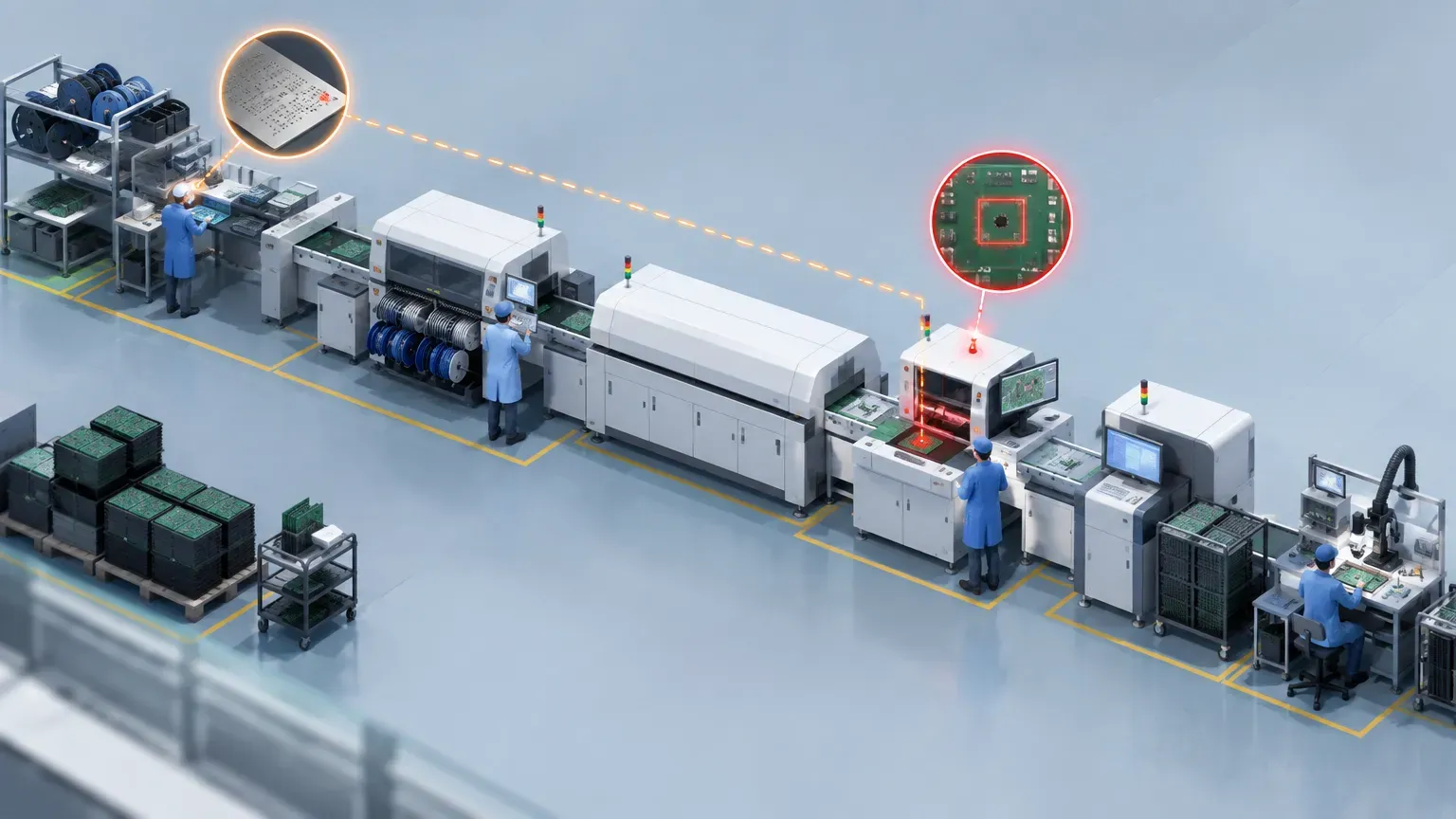
The point where a defect is detected is often not the point where it was created. AOI, ICT, functional test and final inspection are evidence stations. Root-cause analysis needs to connect the observed failure back to the operation, material, program, tooling, machine condition or handling step that introduced it.
The same question belongs to the wider A Defect Reached the Customer. Can Your EMS Operation Contain It Fast Enough? operating picture: defect-origin analysis has to remain connected to the decisions made before and after it, rather than becoming a separate local control.
Detection point can be downstream
A solder issue may be created at printing or reflow and detected at AOI or test. A wrong component can pass visual inspection and fail only during functional test. Start with the defect signature. Record enough detail to distinguish failure modes. 'Test fail' is usually too broad to guide root cause. Map the route backward. Review the operations that could physically create the observed defect. This narrows investigation and avoids changing unrelated processes. Use material genealogy. If the defect correlates with one component lot or approved alternate, material may be the common factor. Use machine and program context. Placement program, feeder, stencil, profile or inspection-program revision can explain clustered defects.
Separate process creation from escape. One control creates the defect; another may have failed to detect it. Improvement may be needed at both points.
Check revision changes
A sudden defect increase after ECN, program or process change is important evidence. Compare before and after. Look for time windows. Defects clustered during a shift, machine event or material change can reveal a process condition that averages hide. Use rework findings. Repair technicians often discover the physical cause more clearly than the original tester. Feed that diagnosis back into quality analysis. Avoid changing many variables at once. If the team changes profile, stencil, material and inspection simultaneously, the real cause becomes hard to prove. Validate the suspected cause. Use controlled evidence where practical: later runs, split lots, parameter checks or repeat builds. Distinguish containment from correction. Adding extra inspection may prevent escapes but does not prove the creating process is fixed.
Update standard work
When the true cause is corrected, update parameter, instruction, fixture or process baseline so the improvement survives staff changes. Use defect origin for cost reduction. Earlier prevention and earlier detection both reduce cost. The best control is often at or near the creating operation. Keep defect taxonomy stable. Changing defect labels repeatedly makes trend analysis difficult. Use a controlled vocabulary with enough detail to support action. Review false failures. Test or AOI can create apparent defects through fixture, program or threshold issues. Separate product defect from detection-system instability. Compare defect timing with process events. Maintenance, changeover, new material, software release or operator shift can create a useful time correlation. Use these events as investigation clues, not automatic conclusions.
Use first-pass and repair data together. A defect can disappear from final yield after repair. Root-cause work should use first-pass failure plus repair diagnosis so the true creating process remains visible.
Confirm correction at source
If solder paste printing created the defect, changing AOI sensitivity may improve detection but not the source. Closure should include evidence that the creating operation improved. Teach quality teams to distinguish correlation. One lot or machine may appear common simply because it handled most volume. Compare defect rate, not just defect count, before concluding causation. Use layered evidence instead of one preferred explanation. Root-cause discussions can become biased toward the first plausible story. A better approach combines several evidence types: defect signature, location on the board, component lot, machine history, program revision, process parameter, operator observations and repair findings. None of these alone proves causation. Together they can build a stronger case. This is especially useful in electronics, where intermittent defects and complex process interactions can make one obvious explanation misleading.
Compare defect rate, not only defect count. A machine or supplier may appear responsible simply because it processed the largest volume. Normalize the evidence. Ten defects from ten thousand units can be a different signal from five defects from one hundred units. The analysis does not need advanced statistics to be useful, but management should compare exposure when deciding whether one line, supplier lot or shift is truly worse. This prevents high-volume resources from being blamed because they naturally generate more absolute defect counts. Use golden units and known-good material carefully. Known-good samples can help separate tester, fixture and product problems. If a failing unit passes on a different fixture while a golden unit fails on the original fixture, the evidence points toward the test environment. Likewise, known-good material can help isolate a suspected component issue. These methods are useful because they change one factor at a time. The controls around golden units, fixture revision and material identity should be strong enough that the diagnostic evidence itself is trustworthy.
Link root cause to the earliest practical control point. The best correction is often applied as close as possible to where the defect is created. If a wrong component is loaded at kitting, checking it only at final test is expensive. If solder paste printing creates the defect, strengthening AOI may reduce escape but not rework cost. Root-cause work should therefore ask where prevention, verification or parameter control can be moved upstream. Earlier control generally reduces the amount of WIP exposed to the same condition.
Verify the process after the fix under normal production
A correction proven by one engineer on a small trial may not survive normal production. Confirm the change on routine operators, normal material supply and the intended equipment. Watch the next several builds for recurrence. This is especially important after NPI, when specialist attention can temporarily make a process look more stable than it is. Effectiveness evidence should come from the process the factory will actually run. Use control charts or trend views only when the data is comparable. Trend tools can help identify drift, but only if measurement method, program revision and product context are stable enough to compare. A sudden change in inspection threshold can make defect rates move even when the process did not. Preserve revision context around the data so quality teams do not chase artificial trends.
Bring maintenance evidence into process investigations. Recurring defects can be related to feeder wear, stencil condition, fixture degradation, calibration or preventive-maintenance gaps. Maintenance history should be available when the evidence points toward equipment condition. This avoids repeatedly adjusting process parameters when the real issue is mechanical deterioration. Document why alternative causes were rejected. A good root-cause record does not need to list every theory, but for important issues it is useful to preserve the evidence that ruled out major alternatives. This helps future teams understand the reasoning and prevents the same disproven explanation from restarting the investigation when a similar symptom returns. Use cross-functional review when evidence crosses boundaries. Some defects sit between supplier, process, test and design. A solder crack can reflect component termination, profile, board design or handling. Bring the relevant functions together when the evidence does not fit one department cleanly. The purpose is not a larger meeting; it is to avoid forcing a complex physical failure into the ownership structure of the organization.
Capture root-cause confidence honestly. Not every investigation proves one cause with complete certainty. Where evidence is strong but not conclusive, record the confidence and the monitoring plan. This is more useful than declaring a weak root cause just to close the issue. Later production and recurrence evidence can strengthen or challenge the conclusion.
What management should measure
Measure defects by detection point and suspected origin, repeat defect after corrective action, defects by machine/program/material lot, false-failure rate, rework diagnosis, escape point, time to root cause and cost of late detection.
A practical review
Take the top defect from last week's production. Mark where it was detected, where it could have been created, which material/program/machine evidence was common, and what later production showed after the corrective action.
Where Epicor Mars fits in defect-origin analysis
For defect-origin analysis, the key system-design question is how to keep enterprise control and electronics-specific execution on the same operating thread. Epicor provides the enterprise-grade ERP foundation for customer orders, purchasing, inventory, planning, costing, finance, approvals and governance. Epicor Mars extends that foundation with the EMS industry context needed at the point of work, including material identity and readiness.
That connection is directly relevant to AOI Found the Defect. Where Was the Defect Actually Created?. Detection point and origin point are often different in electronics production. Quality improvement depends on connecting AOI, test and inspection findings back to the operation, material, machine, program or process condition that created the defect. When the Epicor Mars execution record stays tied to the Epicor work order, material and customer context, management can compare the business commitment with what the factory actually executed without maintaining a second source of truth.
For defect-origin analysis, that complementary positioning is the point: Epicor remains the enterprise-grade foundation, while Epicor Mars adds the EMS workflows needed to make this particular control operational on the factory floor. Explore Epicor Mars for electronics manufacturing.
Frequently asked questions
Is AOI the root cause if it reports the defect?
No. AOI is usually the detection point.
Should every defect have a full formal root-cause project?
No. Scale analysis by risk, recurrence and impact.
Can inspection itself create false failures?
Yes. Fixture, threshold and program instability can create false rejects.
Why separate creation and escape?
Because preventing the defect and improving detection are different corrective actions.