

The Order Needs 8,000 Parts. Why Did You Have to Buy 20,000?
MOQ, SPQ, reel size, NCNR terms and customer-specific components can make purchased quantity far exceed immediate demand. EMS profitability depends on whether excess is reusable inventory, customer liability or future obsolescence risk.
The short answer
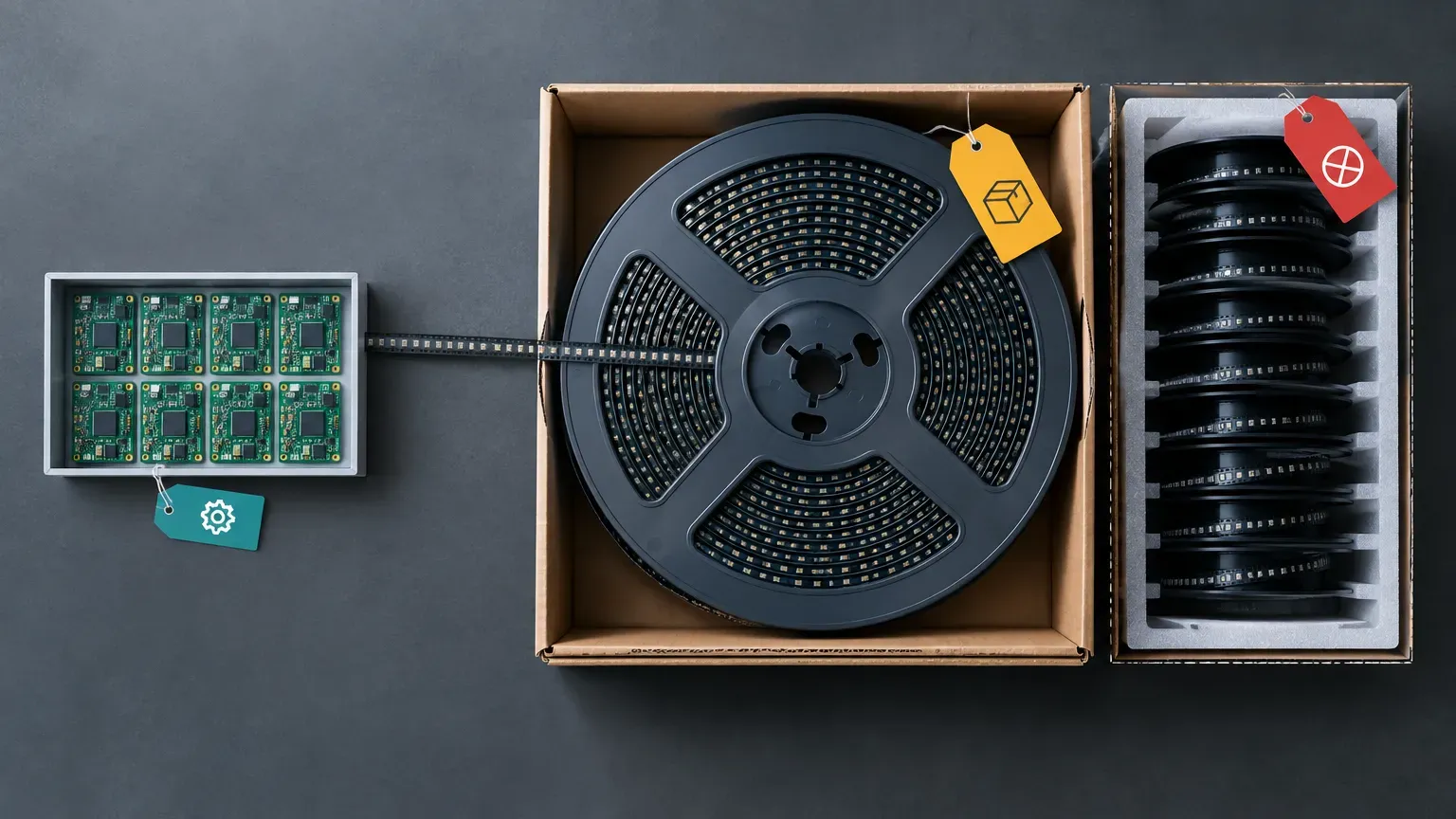
When supplier MOQ, SPQ, reel quantity or NCNR terms exceed immediate demand, the difference should be treated as an inventory and commercial-liability decision—not hidden inside unit cost. The key questions are whether the excess can be reused, who owns the risk, how long it remains valid, and what happens if forecast or revision changes.
The same question belongs to the wider The EMS Quote Looked Profitable. Where Did the Margin Go? operating picture: MOQ, NCNR and excess-material risk has to remain connected to the decisions made before and after it, rather than becoming a separate local control.
Separate requirement from purchase quantity
Show theoretical requirement, safety/attrition allowance and supplier purchase quantity separately. That makes the excess visible. Understand SPQ and reel economics. Electronics components are often sold in standard packs or reels. The economic purchase quantity may be higher than production demand even without a formal MOQ. Classify reusable common stock. Excess of a common component used by many products is different from a customer-specific programmed device or unusual connector. Identify customer-specific excess. If a part exists only because one customer program requires it, the liability should be visible to that account. Use forecast to estimate reuse probability. Future demand can justify carrying excess, but forecast uncertainty should be recognized rather than treated as guaranteed consumption.
Protect NCNR commitments. Non-cancellable/non-returnable purchases deserve stronger approval when demand is not firm because the exit options are limited. Connect excess to ECN risk. A component can be usable today and obsolete tomorrow if a customer changes the BOM. Revision control changes the economic status of the inventory.
Track aging by program
Old excess stock should become more visible as forecast confidence falls and product life changes. Separate physical stock from economic ownership. The material may sit in the EMS warehouse while commercial terms make the customer responsible for some or all of the exposure. Use excess agreements where appropriate. For volatile or customer-specific material, define how excess and obsolete stock will be reviewed and recovered commercially. Avoid charging the first job blindly. Allocating all MOQ excess to the first production order can distort unit economics when the material is expected to support future demand. Avoid assuming all excess has full value. A reel remaining after the order is valuable only if it is usable, saleable and likely to be consumed before obsolescence.
Include minimum-value buys. Suppliers may impose minimum order value even when line-level MOQ is low. Capture the actual commitment. Review canceled or reduced demand quickly. When forecast drops, reclassify the exposed inventory rather than leaving it hidden as normal stock.
Use allocation carefully
Excess common material can support multiple programs, but customer-owned or restricted material should not be redistributed casually. Feed excess history into quotation. Programs that repeatedly create NCNR or excess exposure should have that commercial reality reflected in future terms. Distinguish excess from obsolete. Excess means more stock than current demand. Obsolete means the stock no longer has an approved or practical use. Do not classify both the same way. Excess may retain economic value; obsolete inventory usually requires a disposition decision. Use aging with product lifecycle. A six-month-old common resistor may be low risk, while a six-month-old customer-specific IC can be highly exposed. Aging rules should consider component commonality and product lifecycle, not only days in stock.
Connect excess to cash and space. Even reusable excess consumes working capital and warehouse capacity. Large MOQ positions should therefore be visible even when accounting has not impaired the stock. Review supplier alternatives to reduce future MOQ exposure. If one approved source imposes large MOQ while another source offers smaller packs at a slightly higher unit price, compare total economic exposure. The cheapest piece price may not be the cheapest program decision. Use material-liability rules at quotation. For customer-specific or volatile parts, define whether MOQ, NCNR and excess exposure are covered by the customer, included in price, or accepted by the EMS provider. Doing this at RFQ prevents later disputes when unused stock remains after a forecast reduction.
Track open purchase commitments as well as stock
Exposure exists before material reaches the warehouse. A non-cancellable PO can create liability even when inventory on hand is still zero. Program reviews should therefore include committed quantity, not only physical excess. Use commonality analysis. A component used across many products has a different risk profile from a custom part used by one customer. Estimate how broadly excess can be reused. Commonality can justify a larger buy, while unique material deserves stronger commercial protection. Review shelf-life and handling limits. Some excess material loses value over time because of shelf life, moisture sensitivity, packaging condition or customer date-code rules. Physical stock can therefore remain on hand while its usable economic value declines.
Protect customer-owned excess from reallocation. If the customer has paid for or contractually owns the excess, the company should not automatically consume it for another program. Ownership and reservation status need to remain visible. Use cancellation scenarios. For large NCNR commitments, ask what happens if the customer cancels or reduces demand. A simple scenario can expose whether the agreement and balance sheet can absorb the risk. Link excess to working-capital review. Excess inventory may not reduce gross margin immediately, but it ties up cash. Management should see both profitability and working-capital impact, especially for fast-changing electronics programs. Dispose of obsolete stock deliberately. Once material is clearly unusable, assign a disposition: return, resell where permitted, transfer, service stock, customer settlement or scrap. Leaving obsolete stock in normal inventory hides the economic loss and creates warehouse clutter.
Use program-level material liability registers selectively
For programs with large customer-specific commitments, maintain a concise view of on-hand excess, open NCNR POs, forecast coverage and customer liability. This does not need to become another spreadsheet if the system can assemble the data. The purpose is to make the exposure visible before it becomes obsolete. Review excess at product end-of-life. As a product approaches end-of-life, future reuse probability changes rapidly. Reduce new commitments, review final-buy requirements and clarify who owns residual stock. Waiting until the last shipment to review excess can leave the EMS provider with material that was economically committed months earlier. Treat approved alternates as inventory-flexibility assets. A broader approved manufacturer list can reduce excess and shortage risk because the company has more sourcing options. However, alternates also need quality and customer governance. The economic value of flexibility is strongest when the alternate is already approved before the shortage or MOQ problem occurs.
Watch overbuy caused by inaccurate planning parameters. MOQ is not the only reason excess appears. Incorrect order multiples, safety stock, lead time or forecast consumption can create avoidable overbuy. Separate supplier-imposed exposure from planning-created exposure so the corrective action is targeted. Use transfer opportunities across sites carefully. In a multi-site EMS operation, one plant's excess may satisfy another site's demand if source, customer and traceability rules allow it. Enterprise inventory visibility can reveal this opportunity, but customer-owned or restricted stock must remain protected. Reconcile commercial recovery with physical disposition. If a customer pays for excess material, define what happens to the stock. It may remain reserved, transfer ownership, be shipped to the customer or be scrapped later. Financial recovery and physical inventory status should not drift apart.
What management should measure
Measure excess inventory by customer/program, NCNR commitment, aged excess, customer-specific material, excess created by MOQ/SPQ, material made obsolete by ECN, recovered excess charges, and stock whose forecasted reuse has disappeared.
A practical review
Choose the twenty highest-value excess component positions. For each one, identify original customer/program, physical quantity, current forecast, reuse options, NCNR status, product revision and commercial liability. Any item without a clear future should have an owner.
Where Epicor Mars fits in MOQ, NCNR and excess-material risk
For MOQ, NCNR and excess-material risk, the key system-design question is how to keep enterprise control and electronics-specific execution on the same operating thread. Epicor provides the enterprise-grade ERP foundation for customer orders, purchasing, inventory, planning, costing, finance, approvals and governance. Epicor Mars extends that foundation with the EMS industry context needed at the point of work, including material identity and readiness.
That connection is directly relevant to The Order Needs 8,000 Parts. Why Did You Have to Buy 20,000?. MOQ, SPQ, reel size, NCNR terms and customer-specific components can make purchased quantity far exceed immediate demand. EMS profitability depends on whether excess is reusable inventory, customer liability or future obsolescence risk. When the Epicor Mars execution record stays tied to the Epicor work order, material and customer context, management can compare the business commitment with what the factory actually executed without maintaining a second source of truth.
For MOQ, NCNR and excess-material risk, that complementary positioning is the point: Epicor remains the enterprise-grade foundation, while Epicor Mars adds the EMS workflows needed to make this particular control operational on the factory floor. Explore Epicor Mars for electronics manufacturing.
Frequently asked questions
Is MOQ excess always a loss?
No. It may become reusable inventory or support future forecast.
Should the customer always pay for excess?
That depends on the commercial agreement and why the excess was created.
What makes NCNR especially risky?
The company has limited ability to cancel or return the committed material if demand changes.
Why connect excess to revision control?
Because an ECN can turn usable future inventory into obsolete stock immediately.