

The Pilot Build Passed. What Evidence Says You Are Ready for Volume?
A pilot build should prove more than that a few units can be assembled. EMS teams need evidence on process stability, material issues, test, defects, cycle time, documentation and traceability before declaring volume readiness.
The short answer
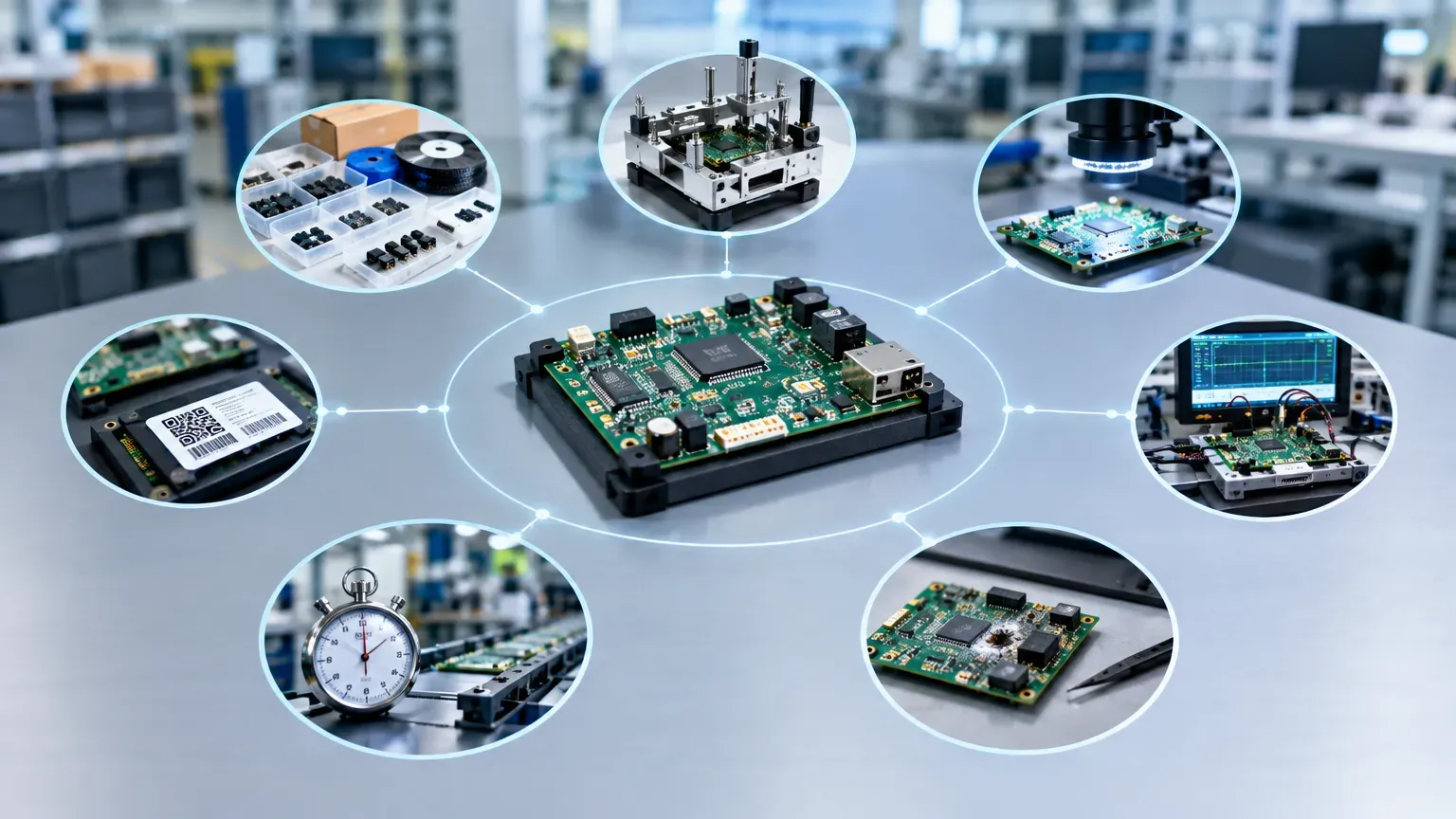
A pilot build proves volume readiness only when it shows that the intended process can be repeated under controlled conditions. A few completed units are not enough. The NPI team needs evidence on material readiness, route execution, setup, defects, test, cycle time, documentation, traceability and unresolved deviations.
The decision should be based on process evidence, not the relief of seeing the first units pass.
The same question belongs to the wider Prototype Built. How Do You Turn NPI Into Stable EMS Production? operating picture: pilot-build readiness has to remain connected to the decisions made before and after it, rather than becoming a separate local control.
Define pilot objectives before the build
Decide what the pilot is meant to prove.
Examples include:
- assembly process;
- test coverage;
- line balance;
- traceability;
- material presentation;
- work instructions;
- packaging.
Without objectives, the team may celebrate output while missing the evidence needed for handover. Build on the intended production route. A pilot should use the route volume production is expected to use where practical.
A special engineering bench can prove product function but not manufacturing readiness. Use production operators. Engineers can compensate for unclear instructions.
Include the people who will run volume.
Their questions are valuable evidence of process clarity. Record actual cycle time. Capture active time, waiting and engineering intervention separately.
The number helps capacity planning only when the conditions behind it are understood.
Capture defects by operation and cause. Do not record only total rejects.
Link defect mode to operation, material, machine or process where possible.
The pilot should produce a useful learning map. Verify material and barcode flow. Test whether receiving/kitting labels, line scans and material verification are practical.
A traceability design that works only in a conference-room diagram needs adjustment before volume.
Verify instructions and revision display
Operators should know which product revision and instructions apply.
If they rely on verbal corrections, the documentation baseline is incomplete. Review test stability. Track false failures, retest, fixture issues and programming problems.
A product can assemble well and still have an unstable test process. Review rework path. When pilot units fail, use the intended rework process.
This reveals whether defect disposition and genealogy remain controlled. List every manual workaround. Temporary manual steps may be acceptable during pilot.
Record them.
Before volume release, decide whether each one becomes a standard process, is automated or is removed. Classify open issues by volume risk. Not every issue blocks handover.
Separate:
- must close before volume;
- accepted temporary deviation;
- improvement after release;
- engineering observation.
The classification should include an owner.
Run a readiness gate after the pilot. Review the evidence as a cross-functional team.
Do not let production readiness become an informal judgment by one function.
Compare planned and actual material behavior
Pilot builds can expose component packaging, feeder, shortage or attrition assumptions that were invisible in engineering.
Feed those findings back into the mBOM and material-readiness rules before volume. Validate production documentation timing. A work instruction updated after every unit may still be in development.
Track how frequently instructions change during the pilot.
A stable process should converge toward fewer changes before handover. Confirm exception workflow. Deliberately test what happens when the wrong material is scanned, an inspection fails or a unit needs rework.
The normal process must handle failure, not only perfect units. Run the pilot like production. A pilot should be controlled enough to expose real factory behavior.
If every material movement, parameter decision and inspection is handled manually by engineering, the team learns little about the standard process.
Use normal receiving, kitting, scanning, routing and quality controls wherever possible.
Temporary exceptions should be recorded explicitly.
Compare first-off and later units. The first unit can require extra adjustment.
Later units show whether the process has settled.
Track whether setup decisions stabilize as the pilot progresses.
If every unit needs a different intervention, the process is still experimental. Measure handoff between operations. Many NPI issues appear not inside an operation but between them.
Examples include:
- missing WIP identity;
- unclear next operation;
- material not transferred;
- incomplete inspection status;
- wrong fixture arriving downstream.
The pilot should test these handoffs because volume production depends on them.
Validate labor assumptions
Prototype engineers may perform tasks that operators will later own.
Record the actual production labor model.
If volume requires specialist engineering time every unit, costing and capacity assumptions may be wrong. Test shortage handling. A pilot may expose a missing component.
Use the intended shortage and alternate-approval workflow.
Do not bypass the process merely because the build quantity is small.
This tests whether the future volume recovery path is workable. Review WIP control. Pilot units can be easy to track manually because there are few of them.
Still use the planned WIP identity and status process.
If the system cannot distinguish units or lots during a small pilot, volume will make the problem worse.
Validate packing and shipment needs. For products approaching customer delivery, include the final pack, labels and documentation in the pilot evidence.
A manufacturing process is not complete if the factory can build the board but cannot release the finished product correctly. Make pilot closure formal. At the end of the pilot, review each objective and issue.
Do not simply move to volume because the planned quantity finished.
Record the readiness decision and any accepted open conditions.
This creates a clear management checkpoint. Include supplier and incoming-quality evidence. Pilot instability can originate before the line.
Track whether critical components arrived from the intended approved source and whether incoming quality matched expectation.
If pilot results depend on hand-selected material, the process has not yet proven normal supply conditions.
Validate line-side replenishment
A small pilot can be fully kitted in advance.
Volume may depend on continuous replenishment.
Test the intended line-side material flow for high-run products so shortages, scan points and ownership are understood before scaling. Review operator training burden. Count how much product-specific instruction is required.
A highly complex process may be acceptable, but management should know the training and certification need.
This influences launch timing and staffing. Use a pilot deviation log. Every time the team departs from the intended process, record why.
Examples include manual material substitution, engineering bypass, extra inspection or alternative routing.
At pilot closure, decide which deviations disappear, remain controlled, or require baseline change.
Verify customer deliverables. Some NPI programs require first-article reports, samples, certificates or traceability evidence.
Include these deliverables in pilot readiness so shipment is not delayed after production succeeds. Test shift-to-shift repeatability. If possible, let more than one operator or shift execute part of the pilot.
A process that works only with the original NPI crew may still contain hidden knowledge.
Compare questions, setup differences and defect patterns.
This is a simple way to test whether the work instructions and material presentation are truly transferable. Verify data flow into enterprise records. Confirm that pilot material issues, completions, scrap and relevant quality events update the designed Epicor/Epicor Mars record correctly.
The pilot is not only validating the physical build.
It should also prove that the operational data required for inventory, costing and management is captured without manual reconstruction.
The result is a pilot that proves both the physical manufacturing process and the digital operating model that volume production will depend on.
It also gives planners a more credible basis for staffing, capacity and customer delivery decisions before the ramp accelerates.
What management should measure
Useful indicators include:
- pilot units built;
- first-pass yield;
- engineering interventions;
- open work-instruction issues;
- fixture/test problems;
- traceability exceptions;
- cycle-time variance;
- deviations carried into volume.
A practical review
After the pilot, ask: could the next batch be built by the normal production team without the NPI team standing beside the line? Every “not yet” answer needs an owner.
Where Epicor Mars fits in pilot-build readiness
For pilot-build readiness, the key system-design question is how to keep enterprise control and electronics-specific execution on the same operating thread. Epicor provides the enterprise-grade ERP foundation for customer orders, purchasing, inventory, planning, costing, finance, approvals and governance. Epicor Mars extends that foundation with the EMS industry context needed at the point of work, including material identity and readiness.
That connection is directly relevant to The Pilot Build Passed. What Evidence Says You Are Ready for Volume?. A pilot build should prove more than that a few units can be assembled. EMS teams need evidence on process stability, material issues, test, defects, cycle time, documentation and traceability before declaring volume readiness. When the Epicor Mars execution record stays tied to the Epicor work order, material and customer context, management can compare the business commitment with what the factory actually executed without maintaining a second source of truth.
For pilot-build readiness, that complementary positioning is the point: Epicor remains the enterprise-grade foundation, while Epicor Mars adds the EMS workflows needed to make this particular control operational on the factory floor. Explore Epicor Mars for electronics manufacturing.
Frequently asked questions
How many units should a pilot build?
There is no universal number. It should be enough to exercise the important process risks and produce meaningful evidence.
Does a passing functional test prove readiness?
No. Manufacturing process, documentation, traceability and repeatability also matter.
Can volume start with open issues?
Yes, if risk, temporary control and ownership are explicit.
Should pilot actual cost be used as the volume standard?
Use it as evidence, but separate engineering/debug effort from repeatable production work.