

Too Many Changeovers? How Do You Sequence High-Mix SMT Without Breaking Priorities?
High-mix SMT scheduling must balance customer priority with feeder setup, component commonality, program change, stencil/tooling readiness and material availability. The best sequence is not simply earliest due date.
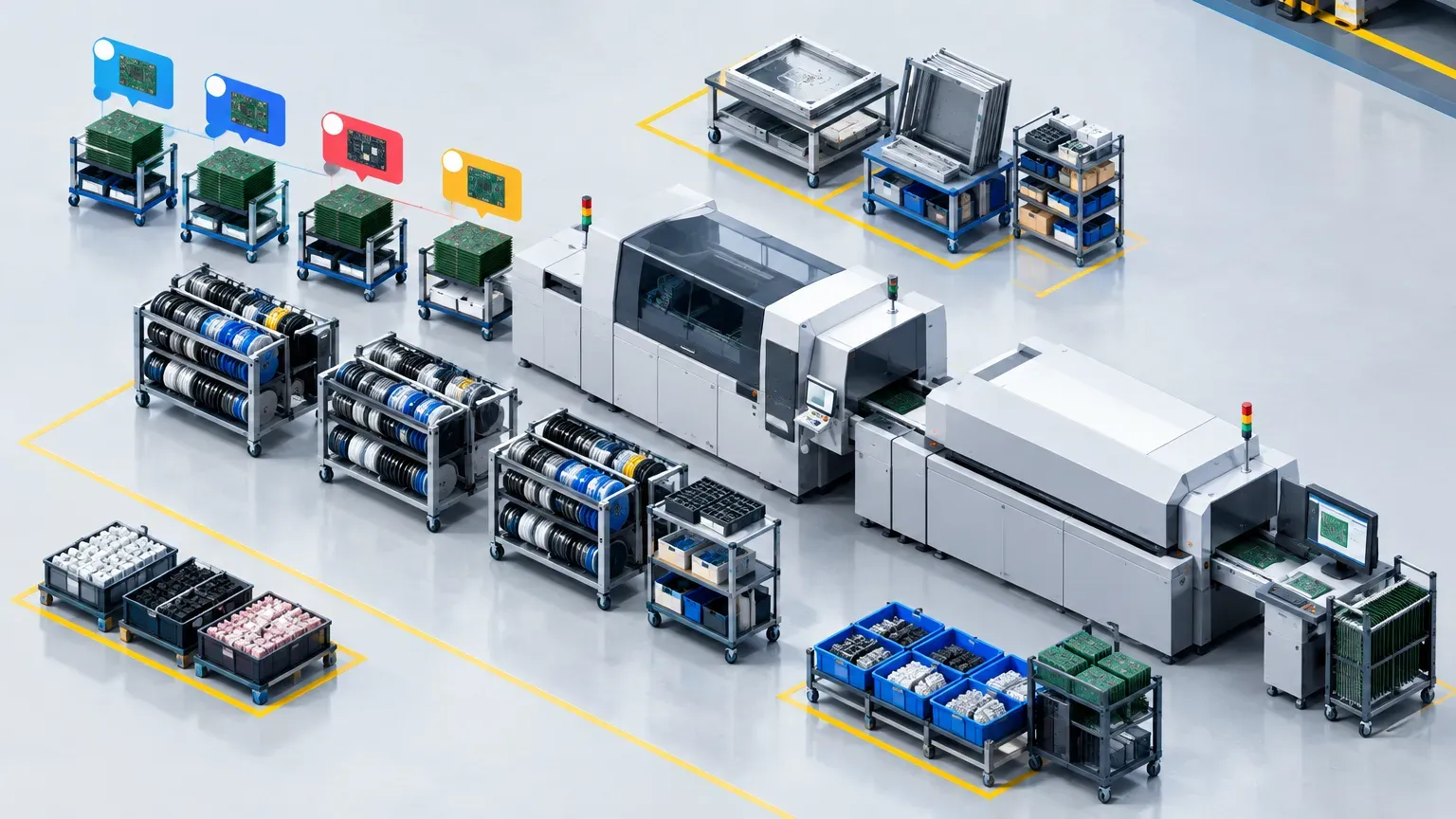
The short answer
High-mix SMT sequencing should balance customer priority with the physical cost of changeover. The best sequence considers due date, material readiness, feeder commonality, stencil/tooling, program readiness, board family and downstream capacity.
Scheduling only by earliest due date can create unnecessary setup. Scheduling only by setup efficiency can miss customer commitments.
The control objective is a sequence that is both service-aware and executable.
The same question belongs to the wider High-Mix EMS Changes Every Day. How Do You Keep Production Under Control? operating picture: high-mix SMT sequencing has to remain connected to the decisions made before and after it, rather than becoming a separate local control.
Understand the changeover components
SMT changeover can include:
- feeder setup;
- component loading;
- stencil change;
- program load;
- nozzle setup;
- board support;
- inspection/AOI program;
- first-off verification.
The time varies by product family.
A sequence that reduces one setup burden can improve effective capacity. Use commonality where it is real. Jobs sharing components, feeders, stencil family or board setup can sometimes run efficiently together.
But commonality should not override material or customer reality.
A job with missing components is not a useful sequence partner. Protect committed due dates. Grouping similar jobs can reduce setup.
Still, the schedule must respect customer commitments.
Use a priority window: identify jobs that must run within the period, then optimize sequence inside that feasible set.
This is more practical than allowing setup optimization to reorder the entire backlog.
Confirm material readiness before sequence lock. Do not schedule a job at the front of the line if critical material is still uncertain.
Material readiness should be a gate for near-term sequence.
This reduces last-minute changes. Confirm program and stencil readiness. A physically kitted job can still fail to start because software, stencil or tooling is unavailable.
The sequence should use a complete readiness definition. Consider downstream constraints. SMT output can overwhelm test, coating or manual assembly.
A locally efficient SMT sequence can create downstream WIP.
Look at the route beyond placement.
This is especially important for products with long functional test.
Use family campaigns carefully
Production families can reduce changeover.
But large campaigns can delay low-volume urgent work.
Define maximum campaign size or review points so efficiency does not become inflexibility. Protect the frozen window. Once feeder carts are prepared and materials staged, casual resequencing becomes expensive.
Use a short frozen window.
Changes inside it should require a clear reason and acknowledgement of displaced work. Measure actual changeover. Planned setup assumptions may be wrong.
Capture actual changeover time by product family.
Identify whether delays come from:
- missing material;
- feeder preparation;
- stencil;
- program;
- first-off inspection;
- operator availability.
This tells management where improvement belongs. Separate external and internal setup. Some preparation can occur while the line runs another job.
Feeder loading, material staging and program verification may be prepared offline.
Improving external setup can reduce line downtime without changing the product sequence.
Use feeder strategy intentionally. Common feeder banks or preloaded carts can support high mix.
But they require accurate component identity and replenishment.
Epicor Mars-style barcode material control can help ensure feeder preparation does not sacrifice traceability. Watch very small jobs. A very short run can spend more time in setup than production.
That may still be commercially valid.
The schedule should simply make the setup burden visible.
Repeated short runs may justify commercial minimums or different production methods.
Include NPI jobs explicitly
NPI can require longer setup, engineering support and first-off checks.
Do not sequence NPI as though it behaves like a mature repeat job.
Use realistic assumptions. Use line eligibility. Not every product can run on every SMT line.
Equipment capability, board size, component package, program and qualification can restrict choices.
The schedule should reflect valid line/product combinations. Use setup families as planning attributes. Product families can encode meaningful commonality such as stencil, feeder set, program platform or board format.
These attributes help planners see changeover opportunities without relying on memory.
Keep the attributes current as products change. Stage feeders and material offline. A high-mix line can reduce downtime by preparing the next job while the current one runs.
This requires accurate material identity and good coordination.
Barcode-driven verification can help confirm that preloaded feeders match the intended job and approved component.
Treat first-off approval as part of changeover. The line is not fully productive until the first-off unit is accepted where required.
Capture that time.
If first-off approval is repeatedly slow, investigate the cause rather than increasing the standard blindly.
Measure schedule adherence after sequence optimization
A sequence that reduces changeover but causes late orders is not successful.
Review both setup efficiency and due-date performance.
This keeps optimization balanced. Use alternate lines selectively. Moving a job to another SMT line may protect delivery.
But program qualification, feeder compatibility or speed can differ.
Use actual line eligibility and performance evidence. Review product design for chronic setup burden. If one family repeatedly creates long changeovers, the issue may be process or product design.
Standardized components, panel formats or tooling can reduce future setup.
Scheduling should not be the only solution. Define the setup content for each family. A “changeover” can mean different work on different lines.
Break it into meaningful elements:
- feeder change;
- stencil;
- program;
- support pins;
- nozzle;
- inspection program;
- first-off approval.
This lets improvement teams identify which element dominates.
Use pre-kitting to protect line time. If material is discovered missing only during changeover, the line becomes a warehouse-check station.
Verify kits before the current run ends.
This pushes shortage discovery upstream and makes the frozen sequence more credible.
Coordinate AOI and test program readiness
SMT sequence can be disrupted when downstream inspection programs are not ready for the same revision.
Include these digital dependencies in the setup-readiness check.
The board should not leave placement and wait because the next station has an obsolete program. Use changeover matrices where helpful. For some lines, switching from product A to B is much easier than from A to C.
A simple setup matrix can represent these differences.
It does not need to be mathematically perfect.
Even rough categories can help planners identify expensive sequence jumps. Separate planned family change from emergency resequence. A planned family change is normal setup.
An emergency resequence often includes extra material movement and preparation loss.
Track them separately.
This shows whether changeover burden comes from product mix or schedule instability.
Use actual sequence history to improve planning. Compare planned and actual job order.
If supervisors frequently resequence the plan, ask why.
They may be responding to information the planning model lacks: material availability, machine condition, operator skill or downstream constraint.
Bring that knowledge into the controlled scheduling process. Include changeover burden in costing where material. If one customer or product family repeatedly requires small urgent runs with heavy setup, the commercial model should eventually see that cost.
Scheduling can reduce the burden, but it cannot eliminate the economics of high-frequency changeover.
Actual setup evidence helps pricing and account teams understand the service model.
What management should measure
Useful indicators include:
- changeovers per shift;
- actual changeover time;
- jobs moved inside frozen window;
- schedule changes due to missing material;
- feeder/stencil/program readiness misses;
- SMT utilization;
- downstream WIP created;
- NPI setup burden;
- due-date misses caused by sequencing.
The aim is not maximum machine utilization.
It is reliable throughput with controlled setup.
A practical review
Take tomorrow's first ten SMT jobs.
For each one, mark customer priority, material readiness, feeder/stencil/program readiness and downstream constraint.
Then compare the current sequence with a setup-efficient sequence.
The difference reveals the real trade-offs.
Where Epicor Mars fits in high-mix SMT sequencing
For high-mix SMT sequencing, the key system-design question is how to keep enterprise control and electronics-specific execution on the same operating thread. Epicor provides the enterprise-grade ERP foundation for customer orders, purchasing, inventory, planning, costing, finance, approvals and governance. Epicor Mars extends that foundation with the EMS industry context needed at the point of work, including material identity and readiness.
That connection is directly relevant to Too Many Changeovers? How Do You Sequence High-Mix SMT Without Breaking Priorities?. High-mix SMT scheduling must balance customer priority with feeder setup, component commonality, program change, stencil/tooling readiness and material availability. The best sequence is not simply earliest due date. When the Epicor Mars execution record stays tied to the Epicor work order, material and customer context, management can compare the business commitment with what the factory actually executed without maintaining a second source of truth.
For high-mix SMT sequencing, that complementary positioning is the point: Epicor remains the enterprise-grade foundation, while Epicor Mars adds the EMS workflows needed to make this particular control operational on the factory floor. Explore Epicor Mars for electronics manufacturing.
Frequently asked questions
Should SMT always run similar products together?
No. Similarity reduces changeover, but due date, material readiness and downstream capacity still matter.
Is machine utilization the best scheduling metric?
No. High utilization can still produce late orders or excess WIP.
How long should the frozen window be?
It depends on feeder preparation, material staging and process stability. Use a period long enough to protect execution but short enough to respond to real change.
Can Epicor Mars replace advanced scheduling?
Epicor Mars can provide EMS execution context; the exact scheduling approach depends on the implementation. The key is connecting the schedule with actual readiness and shop-floor events.