

A Component Passed Receiving. Why Did Supplier Quality Still Reach Production?
Incoming inspection reduces risk but cannot guarantee every component is good. EMS supplier quality needs approved-source control, lot identity, inspection evidence, defect history and forward trace so suspect material can be contained before it spreads.
The short answer
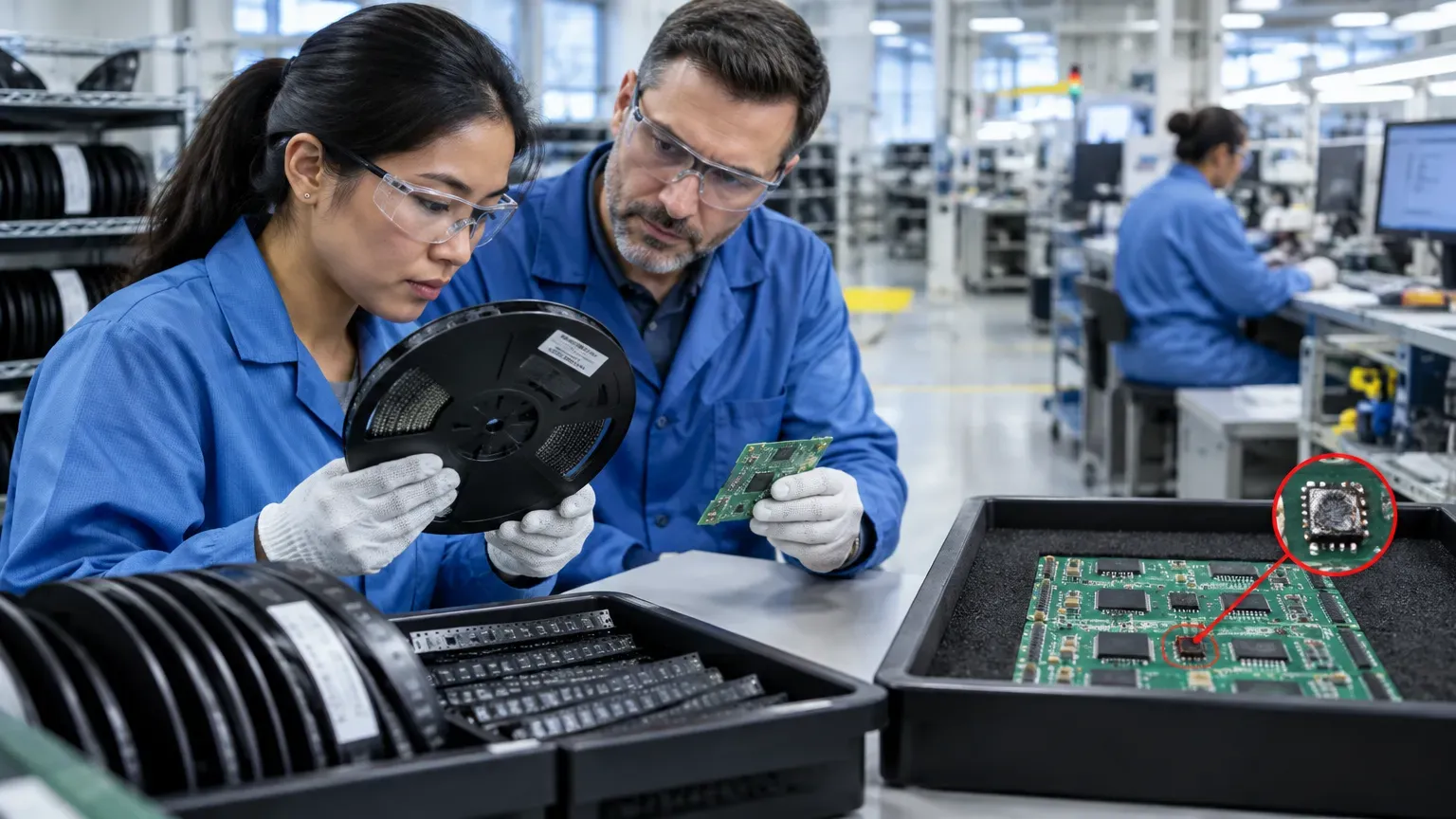
A component can pass receiving inspection and still create a production or customer defect because incoming inspection is only a sample and only tests what the inspection plan is designed to detect. EMS supplier quality therefore needs a wider control chain: approved source, supplier/manufacturer identity, lot/date code, inspection evidence, defect history and forward trace into production.
The same question belongs to the wider A Defect Reached the Customer. Can Your EMS Operation Contain It Fast Enough? operating picture: supplier quality and incoming control has to remain connected to the decisions made before and after it, rather than becoming a separate local control.
Approval does not mean every lot is good
AVL or AML status means a source is permitted. It does not guarantee zero defects. Approved-source governance and lot-level quality evidence solve different problems and need to remain connected. Define supplier and manufacturer identity. A distributor can supply material made by a separate manufacturer. Preserve both identities where quality or customer rules require them. Otherwise the investigation can stop at the commercial supplier and miss the actual manufacturing common factor. Capture lot and date-code evidence. For trace-controlled components, preserve the lot, date code or other manufacturer identity at receipt. That makes later forward trace possible when a supplier alert or field failure appears. Use risk-based incoming inspection. Not every component needs the same inspection depth. Apply stronger controls where supplier performance, component criticality, counterfeit risk, customer requirement or recent defect history justifies them.
Inspection plans should evolve. A supplier can develop a new failure mode that the existing inspection never checked. When defects escape, ask whether the incoming plan should change temporarily or permanently. Separate inspection result from disposition. A failed inspection does not automatically mean the whole lot must be scrapped. The lot may be held, sorted, returned, used under deviation or subjected to additional test. Preserve the decision.
Connect receiving status to inventory availability
Material waiting for inspection or on quality hold should not appear equivalent to unrestricted stock for production readiness. Planning needs to see the true usable quantity. Use supplier history by part and defect. A supplier can perform well overall but poorly on one component family. Review quality at the level where action is meaningful: supplier, manufacturer, part, lot and defect type. Forward-trace suspect material quickly. When one received lot becomes suspect, identify all remaining stock, kits, WIP, completed units and shipments that consumed it. This is where genealogy turns supplier quality into containment capability. Avoid blanket quarantine where evidence is available. If only one manufacturer lot is affected, holding every part number from the supplier can create unnecessary disruption. Use the narrowest defensible scope.
Connect supplier defects to production yield. Some defects are not visible at incoming inspection and appear only after soldering, programming or functional test. Link those production findings back to the incoming lot.
Use supplier corrective action selectively
Recurring, severe or customer-impacting defects should trigger structured supplier corrective action. Minor isolated issues may need a lighter response. Scale governance to risk. Verify later lots. A supplier corrective-action report is not the final evidence. Check whether later receipts show lower recurrence and whether containment actions were removed safely. Include commercial recovery. Supplier defects can create sorting, scrap, rework, premium freight or line interruption. Capture enough cost to support supplier recovery and sourcing decisions. Use approved alternatives as risk mitigation. Where engineering and customer rules permit, multiple approved manufacturers can reduce supply dependency. Quality performance should remain part of the alternate-source decision. Review supplier quality with purchasing. Purchasing sees lead time, price and service; quality sees defect performance. Supplier decisions are stronger when both views use the same evidence.
Use supplier containment levels
For a severe defect, the organization may temporarily require certified lots, 100% supplier inspection, third-party sorting or additional incoming checks. Define the exit condition at the same time the containment is imposed so temporary controls do not become permanent bureaucracy. Review supplier process changes. A supplier can change raw material, tooling, site, sub-supplier or process without changing the commercial part number. For critical components, change-notification governance matters because the quality risk can change while the item master appears unchanged. Protect traceability through repacking. Warehouse repacking can break original lot identity if labels are replaced casually. Preserve the original supplier/manufacturer relationship when material is split into smaller containers.
Use line findings as supplier feedback. Production operators and test stations may see defects incoming inspection cannot reproduce. Create a clean path for those findings to return to supplier quality with lot and usage evidence. Differentiate supplier escape from internal handling damage. A defect discovered in production does not automatically mean the supplier caused it. Components can be damaged by ESD, moisture exposure, incorrect storage, feeder handling, repacking or line-side practices after receipt. Supplier-quality analysis should compare the physical failure mode with the material history. If the same lot performs well on one line and poorly on another, the internal process may be the stronger clue. Keeping supplier lot, storage, movement and operation context connected prevents the organization from launching the wrong corrective action.
Use targeted containment rather than permanent 100% inspection
After a serious supplier defect, 100% incoming inspection can be the right temporary response. It is rarely the best permanent operating model. Extra inspection adds labor, delays material release and can create false confidence if the inspection cannot detect the true failure mode. Define the temporary containment, the evidence required to reduce it, and the longer-term supplier/process action. This keeps receiving from becoming a permanent sorting operation for a supplier problem that should have been corrected at source. Connect supplier changes to NPI and ECN governance. A supplier-related issue can trigger a manufacturer change, alternate component or specification adjustment. That decision should not remain only inside supplier quality. Engineering, purchasing, planning and production need to understand the effectivity and customer approval requirements. The same governance used for NPI and ECN control should therefore connect to supplier-quality recovery. Otherwise the company can solve one incoming defect while accidentally introducing an uncontrolled component change into open work orders.
Review supplier performance by usable output, not only incoming PPM. Incoming defect metrics are useful but incomplete. A supplier lot can pass receiving and create poor SMT yield, test failures, extra rework or field returns. Consider a broader quality view that includes downstream impact where the evidence is strong. This does not mean attributing every production problem to the supplier. It means preserving enough lot-level data to see whether one source repeatedly correlates with lower usable output. That evidence can materially change sourcing, approval and supplier-development decisions. Use supplier-lot holds in production readiness. If a supplier lot becomes suspect, production readiness should change immediately. A work order that looked fully kitted may no longer be executable if critical stock is placed on hold. Planning should therefore consume quality status, not gross inventory. This connection prevents the schedule from repeatedly releasing work against material that quality has already restricted. It also lets customer service see why an apparently well-stocked job is now at risk.
Review supplier quality after engineering substitutions. When an alternate manufacturer is approved because of shortage, monitor early lots carefully. The part may meet technical requirements but behave differently in assembly, test or long-term quality. Temporary enhanced monitoring can provide evidence before the alternate becomes routine. If the source performs well, the extra control can be removed. If it performs poorly, the approval can be reconsidered before a wider population is exposed.
What management should measure
Track incoming defect rate by supplier/part, lots on hold, production defects linked to supplier lots, customer escapes with supplier cause, time to forward-trace, repeat supplier defect, supplier corrective-action recurrence, sort/rework cost and premium recovery cost.
A practical review
Select one component defect from the last quarter. Trace the supplier/manufacturer lot from receipt through inspection, remaining inventory, WIP and finished units. Then check whether the later supplier lots proved the corrective action worked.
Where Epicor Mars fits in supplier quality and incoming control
For supplier quality and incoming control, the key system-design question is how to keep enterprise control and electronics-specific execution on the same operating thread. Epicor provides the enterprise-grade ERP foundation for customer orders, purchasing, inventory, planning, costing, finance, approvals and governance. Epicor Mars extends that foundation with the EMS industry context needed at the point of work, including material identity and readiness.
That connection is directly relevant to A Component Passed Receiving. Why Did Supplier Quality Still Reach Production?. Incoming inspection reduces risk but cannot guarantee every component is good. EMS supplier quality needs approved-source control, lot identity, inspection evidence, defect history and forward trace so suspect material can be contained before it spreads. When the Epicor Mars execution record stays tied to the Epicor work order, material and customer context, management can compare the business commitment with what the factory actually executed without maintaining a second source of truth.
For supplier quality and incoming control, that complementary positioning is the point: Epicor remains the enterprise-grade foundation, while Epicor Mars adds the EMS workflows needed to make this particular control operational on the factory floor. Explore Epicor Mars for electronics manufacturing.
Frequently asked questions
Does passing incoming inspection mean the lot is safe?
No. Inspection reduces risk but cannot detect every possible failure mode.
Should every component be lot-traced?
Only to the level justified by customer, quality and product requirements.
Can approved-source status replace supplier-quality monitoring?
No. Approval defines permission; quality performance shows how the source is actually behaving.
Why link supplier quality to production data?
Because some component failures only become visible after assembly or test.