

The Layout Changed After Quotation. Which Material and Die Assumptions Are No Longer Reliable?
A structural or layout change can alter board yield, die geometry, fit, glue areas and converting behaviour. Treating it as a simple artwork revision can hide cost and execution risk until production begins.
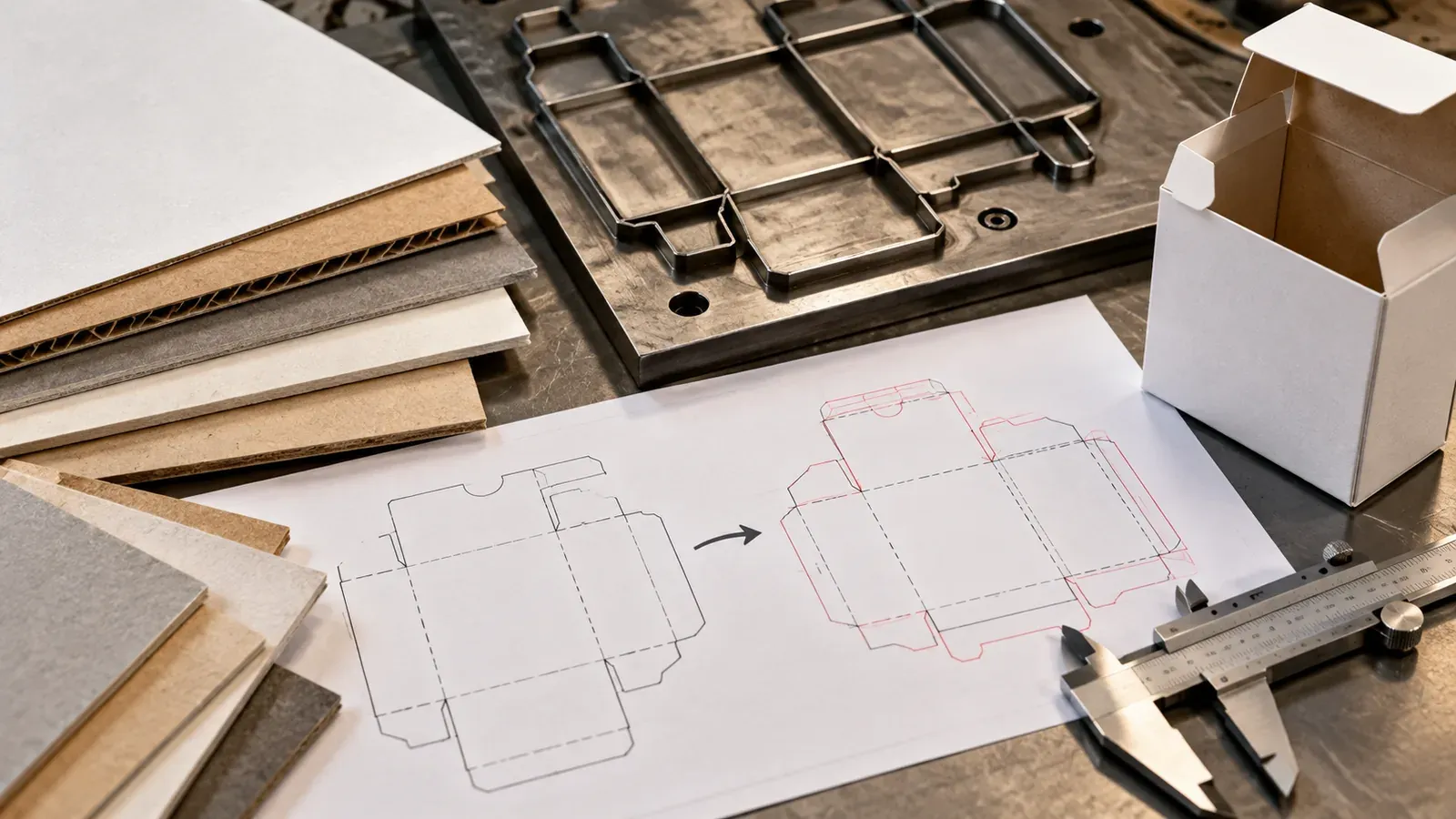
A structural or layout change can alter board yield, die geometry, fit, glue areas and converting behaviour. Treating it as a simple artwork revision can hide cost and execution risk until production begins.
Why this matters
This article examines one operational branch of How Do Change and Version Decisions Create Hidden Risk in Printing and Packaging? and explains how to control packaging layout change material die impact in a practical print-and-packaging workflow.
A layout change can shift both cost and feasibility
When a packaging layout changes after quotation, the first visible effect may be a revised die-line. Hidden underneath are changes to board yield, blank size, sheet utilisation, cutting pattern and converting stress points. A plant that treats layout revision as a design matter only may discover much later that material consumption increased or the new blank no longer behaves well through the converting route. Revalidation should therefore include both economic and technical questions.
Tool geometry should be checked, not assumed
Even small structural moves can affect whether an existing die still works safely. The tool may still cut the shape, but crease placement, fold behaviour, waste stripping or glue flap presentation may no longer match the design intent. Teams should confirm not only whether the old die can be mounted, but whether it still represents the correct geometry and performance for the new blank.
Material behaviour changes when structure changes
A board grade that folded well in the previous design may crack or resist at different panel widths or fold positions. Glue areas may shrink. Window patches or inserts may interact differently. This is why layout revision should look beyond dimensional correctness and consider process behaviour. A structurally correct drawing can still create weak execution if material and route assumptions remain frozen at the earlier state.
Quotation assumptions also need a second look
Commercially, layout changes can invalidate the basis of the quote. If the yield, setup time or tooling requirement changes, the original margin assumption may no longer be true. Capturing that impact matters even if the customer accepts the revised price later, because it helps the business understand how much late structural change actually costs operationally.
This operational issue belongs under the same pillar
The specific question of die-line impact is part of the broader challenge of change control and version management in printing and packaging. The common lesson is that every change should be traced through the assumptions it disturbs rather than through the drawing alone.
Prototype samples provide evidence, not just confidence
A revised mock-up or sample is valuable because it makes hidden fit or folding issues visible before production. However, the sample should be tied clearly to the current version identity and material assumptions. Otherwise it becomes an isolated object that looks right but does not actually represent the released production combination.
Obsolete tooling should be controlled after the decision
Once a new die or structural standard is released, the prior tool should be identified and stored so it cannot return informally on the next repeat order. Many repeat-job mistakes begin because obsolete tools are still accessible and “almost right.” Tool control after the change is therefore as important as tool checking before the run.
Process engineers and customer-facing teams should share the impact
Because layout changes often start in customer conversation, engineering implications can be under-communicated. A stronger workflow gives customer-facing teams visibility into the operational consequences so that feasibility, lead-time and commercial decisions improve over time.
Management checklist
- Confirm the current version identity before action.
- Check which downstream assumptions depended on the previous state.
- Separate obsolete or suspect material physically.
- Assign a clear release or escalation owner.
- Record the impact so the next job benefits from the evidence.
What management should measure
For packaging layout change material die impact, track how often the issue appears, what quantities are placed on hold, the extra setup or proofing time created, and whether the same cause recurs on later jobs. Trend these measures by customer family and process stage so that management can distinguish one-off exceptions from structural weakness. The purpose is not to punish variation; it is to learn where release and version discipline should become stronger.
Frequently asked questions
Is every approved customer change a full restart?
No. The correct response depends on what changed. Some revisions require only a limited revalidation, while others can invalidate tooling, materials or route assumptions and therefore need a much deeper review.
Why are repeat orders still risky?
Because repeat work encourages assumptions. A prior successful run is useful evidence, but it does not prove that the current order still has the same version, material, process and release requirements.
What is the difference between approval and release?
Approval confirms what the customer accepted. Release confirms that the plant has the correct operational combination to execute that accepted version safely and correctly.
Why is shipment proof part of change control?
Because the final question is whether the correct approved version and material actually reached the customer. If that cannot be proven, the change-control chain is incomplete.
Sample-making time should be treated as part of risk reductio
When a revised layout is uncertain, sample making is not simply an extra step to satisfy preference. It is a risk-reduction activity that reveals fit, fold and appearance issues before the job reaches a costly production environment. The time invested in a useful sample often prevents much larger losses later.
Board supply decisions may need to be revisited
A layout revision can alter not only the quantity of board required but also the most suitable grade or calliper. If the design creates more stress at folds or changes the pack geometry, the previous board choice may no longer be ideal. Procurement and production should therefore stay connected when structural revisions occur.
Converting routings should reflect the new structure explicitly
If the change modifies cut, crease or assembly behaviour, the converting routing and setup expectations should be refreshed rather than inherited automatically. This gives operators a fair starting point and prevents them from being surprised by a job that no longer behaves like the prior version.
Tooling history helps predict whether change is routine or exceptional
Plants that keep tooling notes can distinguish between a small update and a revision likely to cause repeated trouble. That history supports better decisions on whether to adapt existing tools, commission new ones or extend make-ready expectations.
Communication with suppliers may need to change as the design changes
If the revised structure affects board behaviour, window material or adhesive needs, suppliers may need updated specifications or lead times. Early communication prevents the plant from discovering too late that its preferred material combination is no longer feasible on the original schedule.
A small geometry change can shift downstream packing efficiency
Layout changes can also influence case count, stacking or pallet efficiency. Those effects are easy to miss because they appear after conversion rather than at the drawing stage. Including downstream packing impact in the review creates a more complete decision picture.
Recalculate sheet utilisation instead of carrying the old yield forward
A structural revision can change the nesting pattern enough to alter the number of blanks obtained from each sheet. Even a modest yield change can materially affect board consumption on a large order. The revised layout should therefore be re-imposed and the expected yield recalculated before the production quantity and material reservation are confirmed. This gives costing, purchasing and scheduling a current basis rather than an assumption inherited from the earlier design.
Check whether the revised blank still fits existing equipment limits
Changes in overall blank size, orientation or flap geometry can affect feeder limits, die-cutting format, stripping requirements or folding-gluing capability. The drawing may be valid in isolation while no longer fitting the preferred production route. An early equipment-capability check prevents the plant from discovering at setup that the job needs another machine, additional handwork or an alternative tool strategy with different lead time and cost.
Review packing dimensions after structural change
A revised carton can change the dimensions or orientation of the finished pack even when the product inside is unchanged. That can affect inner-pack counts, master-carton utilisation, pallet pattern and freight assumptions. Checking these downstream dimensions before release prevents a structural change from creating an unexpected logistics problem after conversion is already complete.