

The Sample Room Knows First: Where Production Risk Appears Before the Plan
The sample room often encounters construction difficulty, material behaviour and workmanship risk weeks before bulk production. The question is whether that knowledge travels.
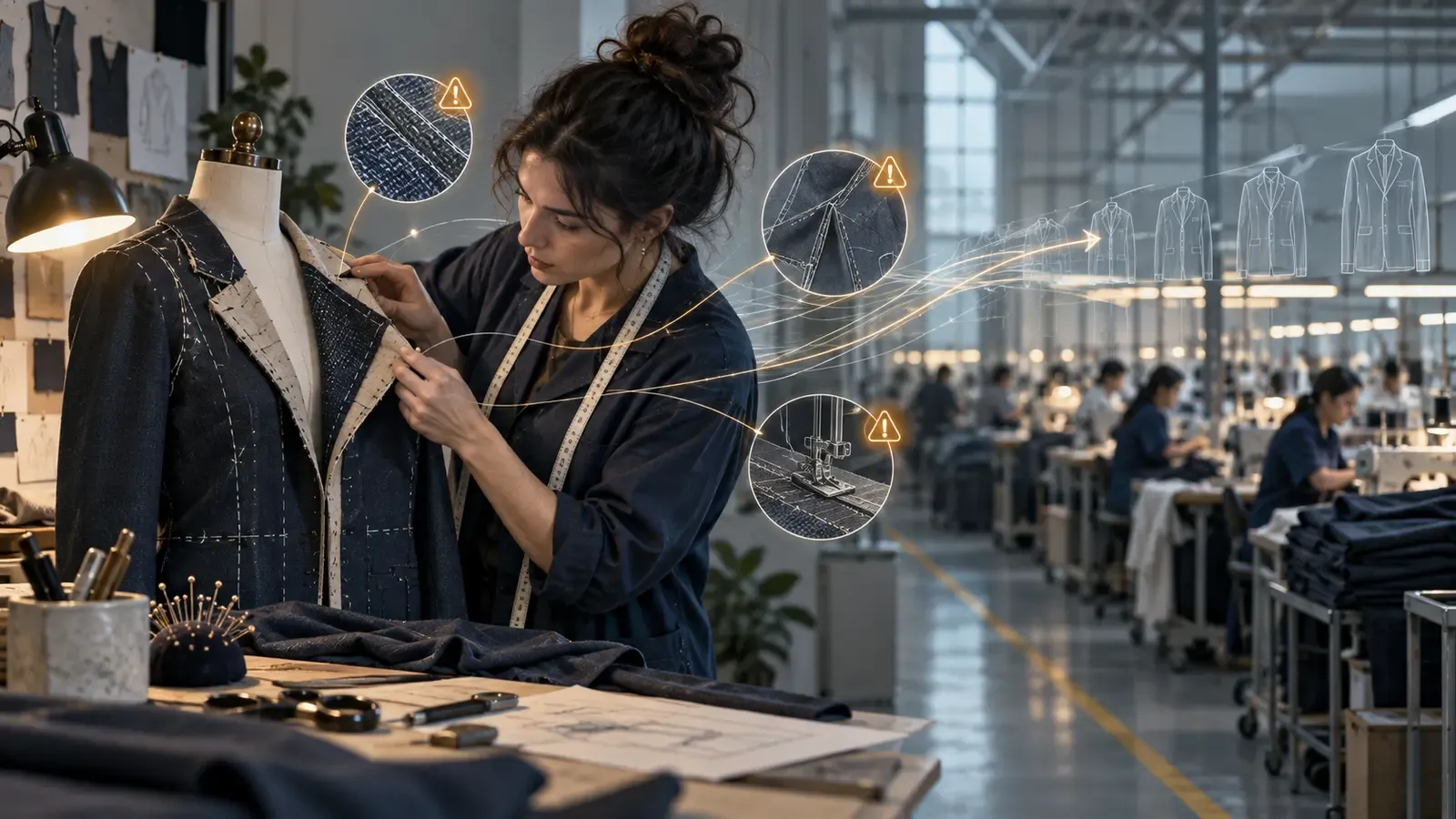
The warning first appears as a pencil mark on the inside of a sample. The fabric slips at the curved seam. The operator changes the handling sequence, adds a temporary guide and tells the technician that bulk production will need care.
The sample is approved. The garment travels to the meeting room; the warning stays with the person who solved it. Six weeks later, a production line discovers the same problem at scale, with thousands of pieces waiting behind it.
The sample room knew first. The business did not.
The short answer
A strong garment sample-room production handover converts sample learning into controlled bulk-production requirements. It records construction difficulty, material behaviour, operation method, machine or attachment needs, quality risks, approval conditions and unresolved questions, then verifies that planning, engineering, purchasing, quality and the factory have acted on them before line input.
The sample is not only an item for buyer approval. It is an early operational experiment.
Why sample knowledge disappears
Sample rooms work under pressure to create a physical answer quickly. Their best knowledge is often tactile and situational: where fabric stretches, which sequence prevents puckering, how much skill a detail needs, whether a seam allowance is forgiving, and which instruction looks simple on paper but is difficult at the machine.
That learning can disappear for several reasons. The maker solves the problem without recording it. Comments describe the visible defect but not the method that prevented it. A technician updates a pattern while production retains an older operation breakdown. The approved sample is sent away. The bulk factory is elsewhere, speaks another operating language or receives only the final specification.
The handover then transfers the product definition but not the production intelligence earned while creating it.
Treat the sample as evidence
Different samples answer different questions: appearance, fit, size, construction, colour, material, workmanship or production method. The organisation should be explicit about what each sample proves—and what it does not.
An approved fit sample does not prove that bulk fabric will behave identically. A beautifully made sample by one expert does not prove a line can repeat the method at rate. A sealed sample may define appearance while leaving the operation sequence unresolved.
Record the evidence behind approval. Note material identity, pattern and specification version, machines and attachments used, difficult operations, deviations from the intended method and any conditions that still require confirmation.
The production-readiness conversation
A useful handover brings together product development and execution before the order becomes urgent.
Construction
Which operations are new, complex or sensitive? Did the sample require unusual handling, temporary fixes or repeated attempts? Are seam, reinforcement and pressing methods defined?
Material behaviour
Did fabric stretch, shrink, fray, mark, shade or react to heat? Are interlining, thread, trim and care requirements confirmed for bulk?
Equipment and method
Which machines, folders, guides, templates or tools were used? Will the production factory have them installed and tested?
Quality
Where is variation most likely? What constitutes acceptance, how will first output be checked, and which defects demand immediate stop and correction?
Capability
What skill level and training are needed? How should the line learn the critical operations before volume builds?
Open decisions
Which comments remain conditional? Who owns them, and what is the latest useful time to resolve them?
The handover should produce actions, not only minutes.
A risk map on the garment
One practical method is to map risk by operation and component. Give each risk a reason, consequence, prevention step and owner. A curved pocket may carry handling and appearance risk; a bonded seam may carry equipment, temperature and durability risk; a delicate trim may carry sourcing and attachment risk.
This map helps production prepare selectively. Not every operation needs special attention. The few that can control quality or flow deserve early trials, operator selection and in-line checks.
It also improves planning. A Sewing Line Is Available. But Is It the Right Line for This Order? shows how product risk and line capability should meet before allocation is treated as capacity.
Do not confuse a perfect sample with a repeatable method
A highly skilled sample maker can compensate for an immature process. They adjust tension by feel, guide the material manually and correct small inaccuracies as they work. The result may be excellent and still be unsuitable as a bulk method.
Ask how the sample was achieved. How many attempts were made? Which adjustments were personal judgement? What cycle time was observed? What would an average trained operator need in order to repeat the result? Can the critical quality point be checked early rather than at final inspection?
The purpose is not to diminish craftsmanship. It is to translate craftsmanship into preparation, tooling, instruction and training that a production team can use.
When the sample room should raise an exception
Not every comment needs escalation. An exception is appropriate when the sample reveals a condition that threatens the agreed promise or crosses functional ownership: material cannot meet the appearance requirement, the intended machine is unavailable, construction is not repeatable at the planned rate, an approval remains open, or the latest revision changes cost or lead time.
Such issues belong in the broader exception economy of garment manufacturing. Tie them to the affected style and order, state the consequence and decision window, and assign the next decision.
This prevents a sample comment from becoming an anonymous note that everyone can see and nobody must resolve.
A pre-production packet people can actually use
Long packs often fail because critical information is buried. Build a concise production view that links to detail when needed:
- effective specification, pattern and material versions;
- approved sample identity and approval conditions;
- operation breakdown and critical method notes;
- machine, attachment, template and tool requirements;
- material-handling observations;
- critical-to-quality points and early check method;
- expected learning risks and training actions;
- unresolved exceptions, owners and deadlines.
Use photographs or diagrams where they make an operation clearer, but do not let an image replace controlled identity. A photo of “the correct pocket” is ambiguous if nobody knows which revision and colour it represents.
Connect product development to live operations
ACC describes Venus as garment ERP supporting sample management alongside order, material, costing and production processes. See the official Venus overview for current product information.
The important design principle is continuity. Sample identity, comments and approvals should connect to the effective style and order requirements. Production readiness should be visible before planning commits line input. When bulk results arrive, they should inform future sample and method decisions.
This creates a learning loop. If a construction repeatedly causes startup loss or repair, product development can change the method, provide better tooling or adjust the planned rate. Without the loop, every new order rediscovers the same lesson.
The meeting that should happen before the meeting
Many factories hold a pre-production meeting shortly before input. It can be useful, but a late meeting cannot manufacture missing attachments, repeat testing or train a team instantly.
Split readiness into stages. At order confirmation, identify long-lead technical requirements. After sample learning, raise construction and material risks. Before allocation, test the line-capability match. Before input, verify physical readiness and close open approvals.
The final meeting then confirms readiness instead of discovering it.
Measures that reward learning transfer
Track whether knowledge arrives early enough to change preparation. Useful measures include:
- critical sample issues closed before bulk release;
- line-input delays caused by missing technical readiness;
- time to first acceptable production output;
- startup defects linked to known sample-room observations;
- special equipment ready by the planned date;
- repeated construction problems across seasons or factories;
- open approval conditions at line input.
Avoid rewarding sample-room speed alone. A sample completed quickly can create downstream cost if essential learning is not captured.
Frequently asked questions
What should a garment sample-room handover include?
It should include the effective versions, approval conditions, construction and material risks, operation method, equipment needs, critical quality points, training actions and unresolved decisions.
Is an approved sample enough for bulk production?
No. It may define the required result, but production also needs a repeatable method, the correct resources and clear handling of remaining conditions.
Who owns sample-to-production transfer?
Ownership is cross-functional. Product development or technical teams usually coordinate, while planning, engineering, materials, quality and factory operations must accept and act on their parts.
When should production engineering become involved?
As soon as sample learning suggests a method, equipment, skill or rate risk. Waiting until line input turns preparation into recovery.
How can sample learning improve future costing?
Actual method, skill, equipment, learning and quality evidence can refine labour and risk assumptions for comparable styles.
Let the first garment teach the thousandth
The sample room is one of the earliest places where a commercial idea meets physical reality. It sees the gap between a drawing and a repeatable garment. That makes it a source of operational foresight, not simply a service that produces approvals.
When its knowledge travels, a factory can prepare machines, methods, people and controls before volume makes the problem expensive. When it does not, bulk production pays to learn a lesson that was already known.
The pencil mark inside the sample is not a minor note. It may be the earliest available warning about the order’s future—and the cheapest moment to act on it.