

One Defect Was Found. How Much Work Does It Put Back at Risk?
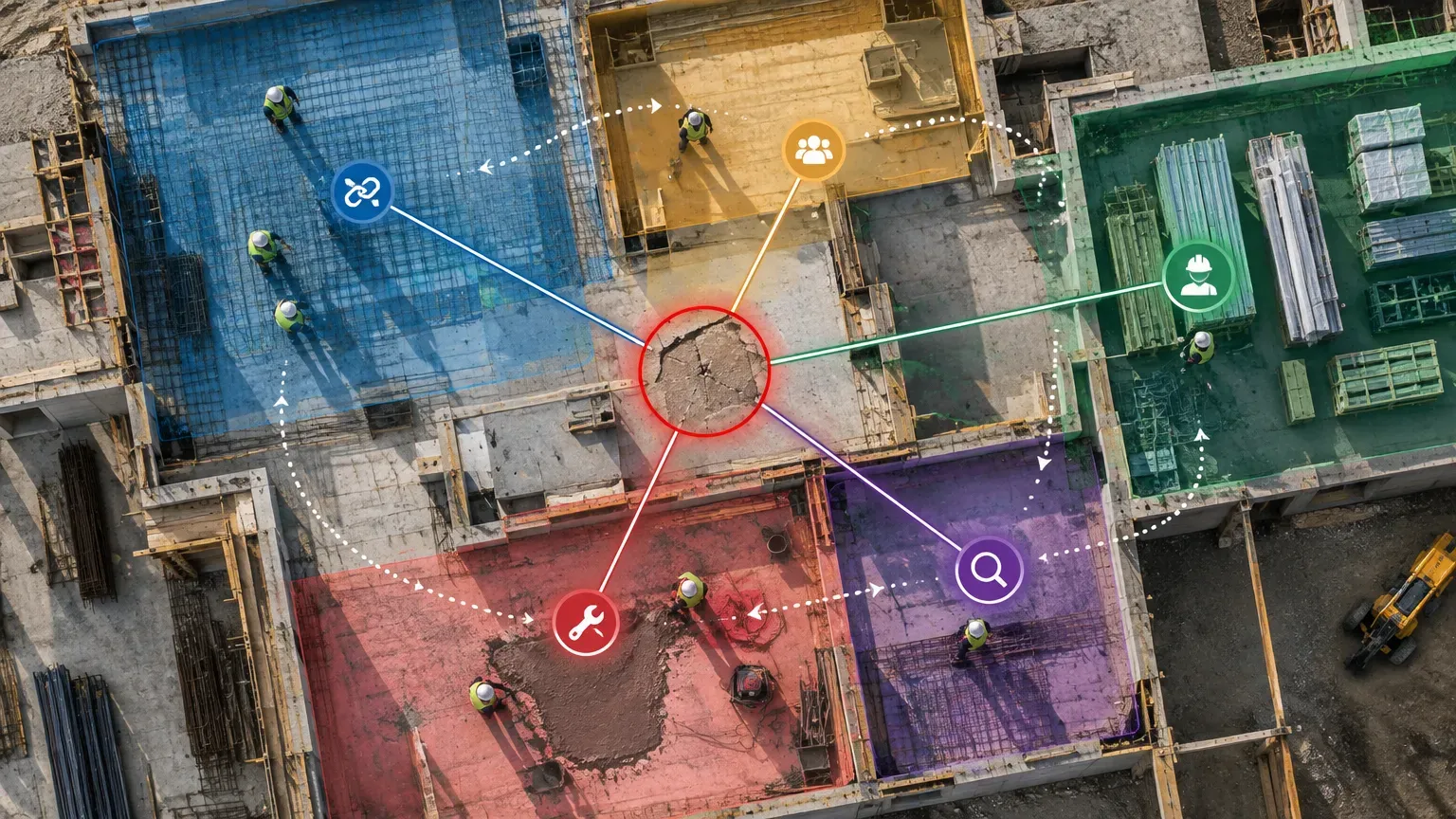
A defect is not just a repair task. It may affect adjacent work, completed quantities, inspection status, subcontract responsibility and downstream sequence. The real question is how far the consequence travels.
The short answer
A defect is not defined only by the repair it needs.
Its real significance is the amount of completed or near-completed work that it puts back into doubt.
One failed detail may be isolated. Or it may reveal that the same material, method or workmanship issue exists across several areas.
The management task is to understand how far the cause may have travelled before the project closes the visible symptom.
The first defect is evidence, not just an inconvenience
A defect naturally creates urgency.
The site wants the issue fixed.
The subcontractor wants reinspection.
The programme wants the area released.
Those pressures can push the project toward the fastest local repair.
Sometimes that is enough.
But the first defect may also be the first visible evidence of a repeated condition.
The same crew may have used the same method elsewhere.
The same material batch may appear in other areas.
The same drawing detail may have been repeated throughout the project.
The useful question is not only “how do we fix this?”
It is “where else could the same cause exist?”
An NCR can be closed while the underlying risk remains open
Nonconformance reports create a formal path to disposition and closure.
That process is necessary.
Closure can still become too narrow if it focuses only on the identified location.
Suppose a fixing detail fails inspection.
The NCR records the area.
A repair is agreed.
The work is reinspected and passes.
Administratively, the issue is closed.
If the same detail was installed in twenty other locations, the project may have solved only the first discovery.
The root-cause review should be proportionate to the risk.
Not every defect justifies a wider investigation.
Repeated, systemic or safety-critical conditions often do.
Rework has a longer cost tail than the repair hours
The visible repair is only part of rework cost.
The project may also spend time reopening access, removing finishes, moving material, supervising the repair, arranging reinspection and resequencing other trades.
The defect may disrupt another subcontractor even if that team did nothing wrong.
That is why rework can be expensive even when the repair itself appears small.
The wider completion-control view should therefore treat defects as production events, not only quality events.
The consequence can travel into programme, labour, plant, subcontract cost and final acceptance.
Root cause should lead to a different future condition
“Workmanship” is often too vague to be useful.
If workmanship is the cause, what specifically changed?
Was the method unclear?
Was supervision insufficient?
Was the crew inexperienced?
Was access poor?
Was the programme forcing work out of sequence?
Did the approved detail create unnecessary difficulty?
A useful root cause changes something.
Training.
Method.
Inspection point.
Material handling.
Design detail.
Supervision.
Sequence.
If the project closes the NCR with no change to the condition that created it, recurrence is likely.
Defect trends matter more than the raw count
A project can have many small defects and still be improving.
Another can have fewer defects but a worsening pattern in one critical package.
Count alone does not tell management enough.
Where are defects appearing?
Which trade?
Which type?
At what stage?
Are they found before or after work is covered?
Do the same causes recur?
Trend allows the project to intervene before closeout becomes overwhelmed.
It also helps distinguish a normal level of finishing correction from a deeper quality problem.
Rework can distort reported progress
This is easy to miss.
If work is installed, counted as complete and later removed for repair, the project may have overstated true progress.
The same quantity gets worked twice.
Labour increases.
Final installed quantity does not.
This affects productivity and can complicate earned progress.
A mature project should understand whether significant rework is sitting behind otherwise positive progress numbers.
The site may look close to completion while substantial effort remains in reopening and correcting work already counted.
Defect ownership should not obscure project responsibility
Commercially, the project may need to establish which subcontractor or supplier owns the defect cost.
Operationally, the first priority is different.
Protect the work.
Understand the extent.
Prevent recurrence.
Restore the sequence.
If teams focus only on cost ownership, technical closure can slow down.
If they ignore responsibility completely, the project may absorb cost that belongs elsewhere.
Both views matter.
The production response and the commercial response should proceed in parallel rather than wait on one another.
One useful distinction is between defect discovery and defect creation.
A defect found late may have been created much earlier.
If the project only measures defects when they are discovered, one trade or phase can appear worse than it really is.
Management should understand where the condition originated, where it was found and how much work had already progressed in between.
That timeline helps the project strengthen the right control point.
It may show that inspection needs to move earlier, that a method needs changing or that a recurring detail should be redesigned before more work is installed.
Defect management also needs a sense of timing.
The same defect costs far less when found immediately than when discovered after several downstream activities have built over it.
A misaligned opening corrected before finishes is inconvenient.
The same issue found after services, ceilings and finishes are complete can require several trades to reopen work.
This is why early detection matters as much as defect prevention.
The project should ask where in the sequence the defect was created and where it was discovered.
A long gap between those two points is itself a control weakness.
It means the process allowed nonconforming work to move downstream before somebody challenged it.
That insight can change inspection strategy.
The project may need an earlier hold point, stronger self-check or clearer acceptance criteria.
There is also a forecasting implication.
If a recurring defect affects work not yet inspected, the project may already carry future rework exposure that has not reached the cost report.
Management should not wait until every location fails formally before recognising the likely consequence.
Evidence from the first few defects can support a reasonable estimate of the wider risk.
That allows the project to reserve resources, protect the programme and engage the responsible subcontractor earlier.
It also makes the commercial conversation more credible.
Instead of presenting one large late claim for rework, the project has a clear record showing how the issue emerged, how far it spread and what was done to contain it.
Defect control is therefore most useful when it reduces uncertainty quickly.
The project needs to know whether the problem is contained, repeating or still expanding.
That is a much stronger management question than simply asking how many NCRs remain open.
The project should also understand the difference between containment and permanent correction.
Containment protects the immediate work. It may stop installation, isolate a material batch or inspect similar locations.
Permanent correction addresses the reason the defect occurred.
Both matter, and they happen on different timescales.
A project under programme pressure can become very good at containment because it allows work to restart quickly. If the permanent cause is not addressed, the same issue can reappear elsewhere and create a larger closeout burden later.
That is why recurring NCRs deserve a wider management conversation.
The question is no longer only whether each item has been closed. It is whether the project is learning quickly enough to reduce future occurrence.
A declining recurrence rate is a much stronger sign of quality maturity than a high volume of administrative closures.
Where Epicor Saturn fits in defect and rework control
Epicor provides the enterprise-grade ERP foundation for approvals, purchasing, commitments, finance and governance. Epicor Saturn adds the construction and engineering project context that connects defects with workfronts, subcontract packages, progress, rework and project cost.
That connection helps the project understand both the physical consequence and the commercial exposure of nonconforming work.
Epicor Saturn provides the project-centric industry layer while Epicor supplies the enterprise-grade transactional foundation beneath it. Explore Epicor Saturn for construction and engineering.
Frequently asked questions
Does every defect require an NCR?
No. The required process depends on the project’s quality system, severity and contractual requirements.
When should one defect trigger a wider review?
When the cause may be repeated across locations, materials, crews or design details.
Why does rework affect productivity so strongly?
Because labour and plant are consumed without increasing final net installed output.
Should commercial responsibility be resolved before repair?
Not necessarily. Operational closure may need to proceed while cost responsibility is assessed separately.