

Too Many Trades Are Working at Once. Is the Site Becoming Less Productive?
Trade stacking can make a project look accelerated while reducing real output. Congestion, shared access, safety controls, material conflict and supervision load can turn extra crews into lower productivity.
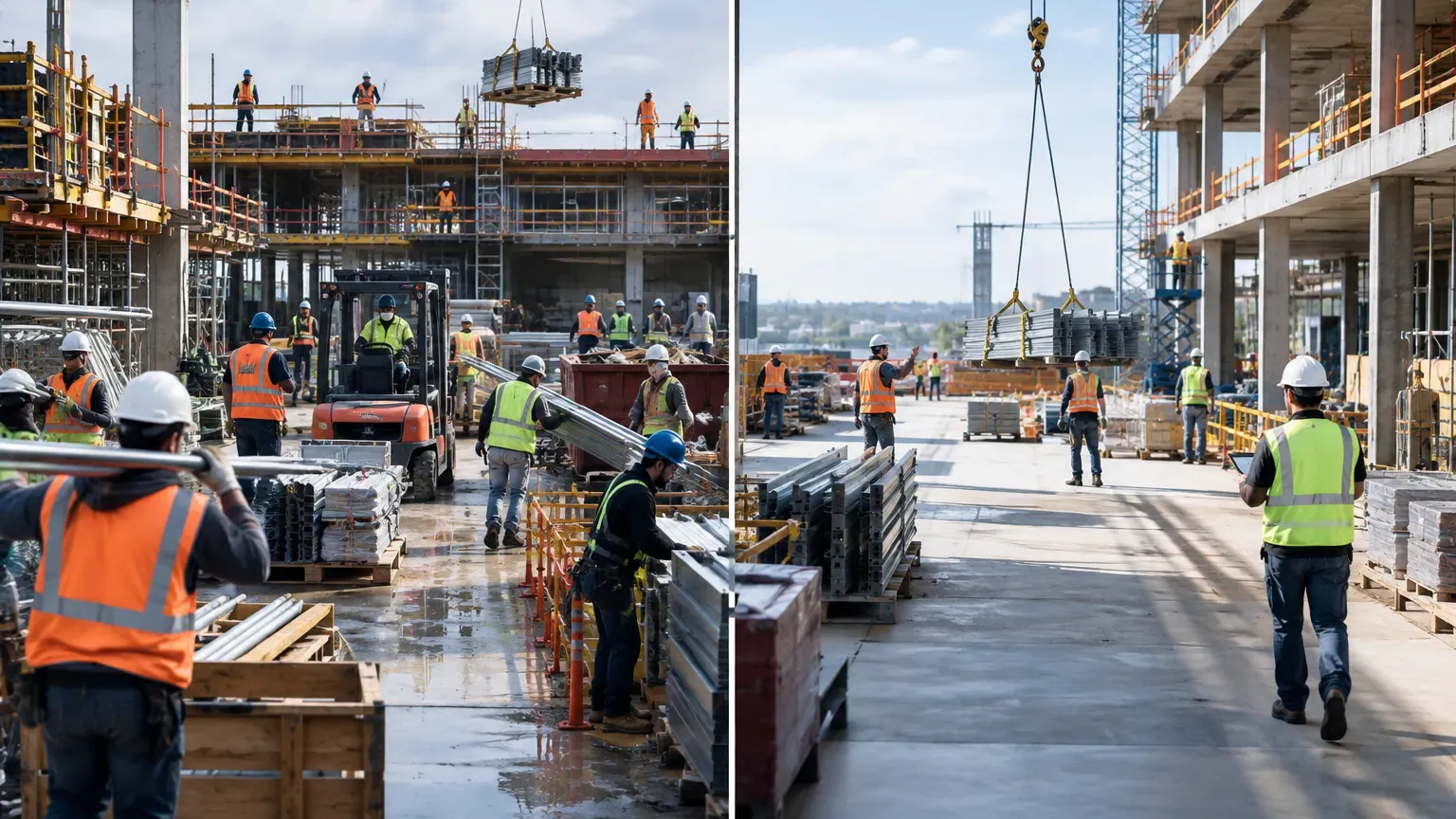
The short answer
Putting more trades into the same workfront can make a project look accelerated while reducing real productivity.
Congestion changes access, supervision, safety controls, material flow and sequence. Crews spend more time working around one another and less time completing their own scope.
The site becomes busier.
The production system can become slower.
Trade stacking is often a programme decision disguised as a resource decision
When a project falls behind, management wants visible recovery.
Additional crews are mobilised.
More subcontractors are pushed into the same area.
The logic is simple: more people should mean more output.
That logic assumes the workfront can absorb the extra labour.
Often it cannot.
The area has limited access. Several trades need the same lifting route. Materials compete for storage. Safety segregation reduces usable space. Supervisors have more interfaces to coordinate.
The project has increased resource without increasing workfront capacity.
That is when trade stacking becomes counterproductive.
Congestion rarely appears as one dramatic event
The productivity loss is usually fragmented.
A crew waits ten minutes for access.
Another moves material twice.
A supervisor pauses work to coordinate a shared area.
One trade stops while another finishes an interface.
Each delay looks small.
Across several crews and a full day, the cumulative effect can be substantial.
This is why congestion is easy to underestimate.
The site still looks active.
Nobody is obviously idle for hours.
But unit productivity deteriorates because every task contains more friction.
The wider site-production picture becomes important here because labour hours and installed quantities reveal what visual activity can hide.
More supervision is not the same as more coordination capacity
Trade stacking also increases management load.
More crews mean more permits, interfaces, deliveries, inspections, safety controls and short-term decisions.
The site may add labour faster than it adds coordination capacity.
Supervisors then spend more time resolving conflicts.
Engineers respond to more questions.
Logistics becomes reactive.
The crews may be technically capable of producing more, but the management system around them becomes saturated.
This is one reason acceleration plans can underperform even when enough labour is available.
The project has expanded the production system unevenly.
Shared access is often the hidden bottleneck
Physical access frequently determines how many trades a workfront can support.
One hoist.
One corridor.
One loading bay.
One scaffold route.
One crane.
If several trades depend on the same access, adding labour increases queueing rather than output.
The bottleneck may sit outside the activity managers are trying to accelerate.
This is why workfront capacity should be considered before resource is added.
Which shared resource limits the area?
How many crews can genuinely operate without interfering?
What sequence protects the highest-value work?
These questions can reveal that fewer simultaneous trades may produce more total progress.
Safety controls can reduce usable production space
Congestion is not only a productivity concern.
It changes safety conditions.
More people, plant and material in the same area create additional exclusion zones, lifting interfaces, housekeeping requirements and access conflicts.
The project may need more controls, which further reduce usable space.
This is entirely appropriate from a safety perspective.
But the programme should recognise the production consequence.
If the acceleration plan assumes all crews can work independently while safety controls require separation, the planned output is unrealistic.
The solution is better sequencing, not weaker safety control.
The strongest recovery plan sometimes removes crews
This can be counterintuitive.
A delayed project may improve output by reducing simultaneous activity in a constrained area.
One trade completes a clean workfront.
The next trade enters with less interference.
Material routes stay clear.
Supervision becomes easier.
The site may appear less busy while production becomes more reliable.
This is why management should be willing to challenge the assumption that resource volume equals recovery.
Recovery is about completed work.
Not visible effort.
Congestion can also create commercial friction
Trade stacking can also distort performance comparisons between subcontractors. One package may look inefficient simply because it is working in the most congested phase of the project, while another achieved stronger rates under cleaner conditions.
Fair performance review needs to recognise those differences. Otherwise the project risks drawing the wrong conclusion about both subcontractor capability and future pricing.
Trade stacking affects subcontract relationships.
A subcontractor priced a productivity assumption based on reasonable access and sequence.
If the project later compresses several trades into the same area, the contractor may face disruption claims, reduced productivity or requests for additional resource.
The commercial consequence can outlast the period of acceleration.
That does not mean the project should never stack trades.
It means the decision should acknowledge the productivity and contractual effect.
A recovery plan that protects the programme while destroying package economics may not be a good recovery plan.
Congestion also has a tendency to become self-reinforcing.
One trade falls behind, so extra labour is added. The added labour creates more interference. Another trade then falls behind and also adds resource.
The workfront becomes progressively harder to manage.
Breaking that cycle may require a deliberate decision to sequence rather than stack.
That can look slower in a recovery meeting because fewer activities run simultaneously. In practice, the site may complete more usable work because each trade gets a cleaner window.
The best measure is therefore not the number of active crews.
It is reliable completed output across the whole workfront.
Congestion should be visible before the site starts paying for it
Trade stacking is often obvious once the workfront is already crowded.
By then, the project has mobilised the crews and created the interference.
A stronger control looks ahead.
For the next major area, how many trades are expected to work there at the same time?
Which shared access, lifting or storage routes do they depend on?
Which activities create exclusion zones?
Which crew needs uninterrupted sequence to achieve its planned rate?
These questions can reveal future congestion while the programme still has room to change.
This is especially important during recovery planning.
A compressed programme can show several parallel activities that are logically possible on paper but physically incompatible on site.
The programme may therefore contain concurrency that the workfront cannot absorb.
Management should challenge that before promising the recovery.
There is also a cost forecasting implication.
If extra crews are mobilised into congested conditions, the project should not assume each additional person will deliver the original productivity rate.
The marginal output from each new crew may fall.
At some point, adding resource increases cost faster than progress.
That point is different for every workfront.
The project does not need a perfect mathematical model.
It needs enough operational judgement to recognise when acceleration has crossed into interference.
That is the moment to change sequence rather than continue adding people.
This is especially relevant when acceleration is commercially sensitive. The project should be able to explain whether extra resource produced proportionate additional output or mainly increased interference.
That evidence gives management a better basis for deciding whether the same strategy should continue.
The same question applies to shared supervision. A workfront may physically fit another crew while the management capacity around it is already saturated.
If permits, inspections, coordination and decisions cannot keep pace, extra labour will still create waiting. Workfront capacity therefore includes the people who control the work, not only the physical space.
It also gives planners a better basis for deciding when parallel work is genuinely useful and when it simply creates interference.
Where Epicor Saturn fits in workfront congestion control
Epicor provides the enterprise-grade ERP foundation for purchasing, finance, approvals and resource-related transactions. Epicor Saturn adds the construction and engineering project context that connects workfronts, resources, site activity, subcontract packages and project cost.
That connection helps management understand whether additional resource is increasing output or simply increasing congestion and cost.
For congestion control, Epicor Saturn connects workfront conditions and resource decisions to the wider project record, with Epicor providing the enterprise-grade ERP foundation. Explore Epicor Saturn for construction and engineering.
Frequently asked questions
Does trade stacking always reduce productivity?
No. It depends on workfront capacity, access, interfaces and coordination.
Why can fewer crews produce more?
Because cleaner sequencing can reduce waiting, congestion and interference.
Is congestion mainly a safety issue?
No. Safety is critical, but congestion also affects productivity, logistics, supervision and commercial performance.
Should acceleration plans include productivity assumptions?
Yes. Additional resource should be assessed against the workfront’s real capacity.