

A Thousand Sheets Entered Finishing. How Many Good Cartons Came Out?
Input quantity is not finished quantity. Splits, spoilage, holds and rework must remain visible if a packaging plant wants to know what it can really ship.
The short answer
Production status is credible only when quantity travels with it. Printing and packaging plants need to distinguish input, good output, expected and abnormal spoilage, hold, rework, samples, transfers and packed units at every operation. “Finishing complete” is not enough if nobody can explain how a thousand sheets became 8,760 acceptable cartons.
The quantity that disappeared
The press record says 1,000 sheets were released. Die-cutting reports completion. The folder-gluer is waiting for the full batch, but the pallet beside the machine is clearly short.
The explanation arrives in fragments. Some sheets were used for setup, some were rejected for print variation, a stack is on quality hold, and two bundles went to a customer sample request. Each movement was reasonable. Together, they created a quantity nobody owns.
When the dispatch team asks what can ship, “job complete” becomes an unhelpful answer.
Follow quantity through transformations
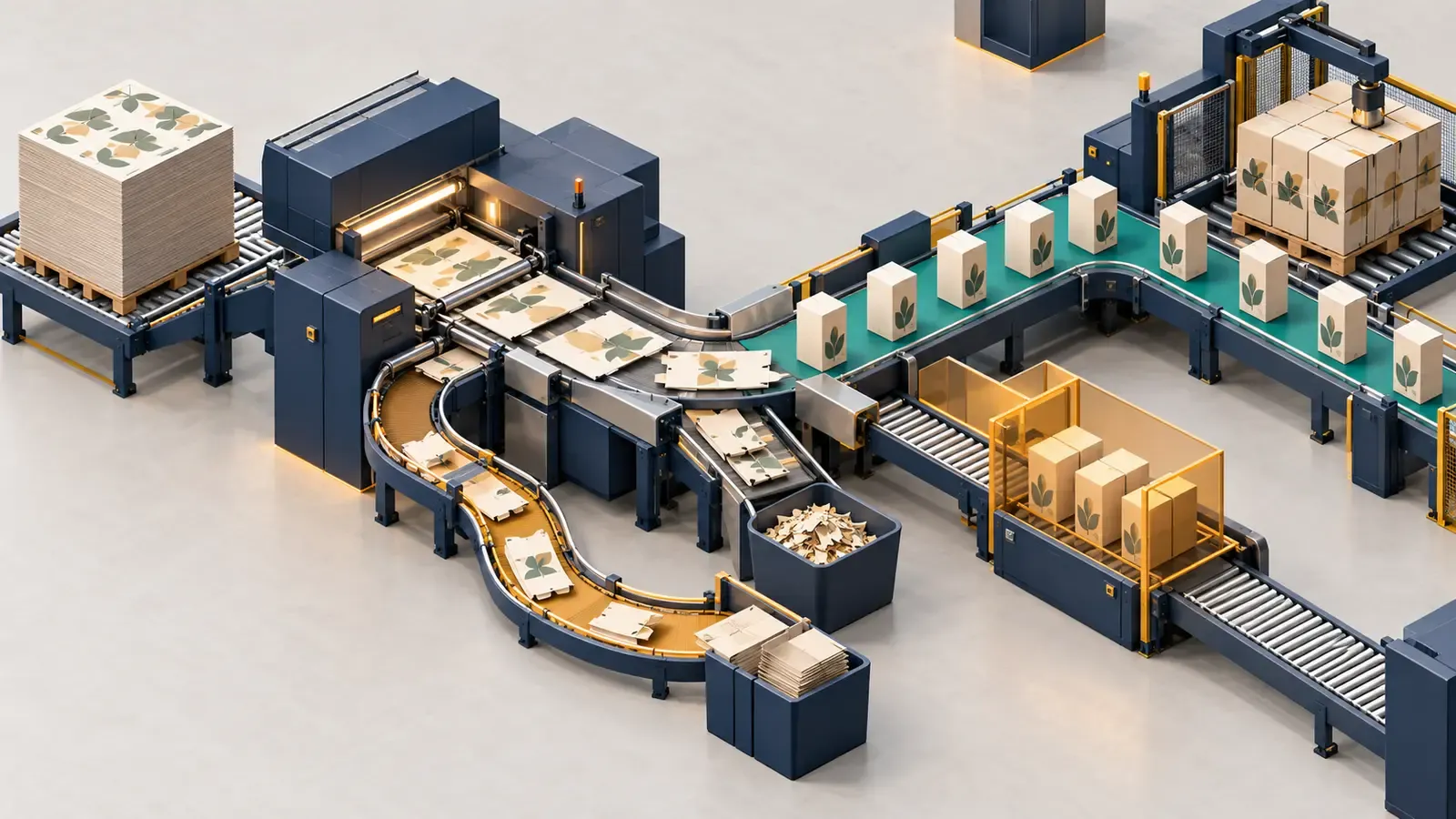
Packaging work changes its unit of measure. Sheets become blanks; blanks become cartons; cartons become bundles, cases and pallets. One-up and multi-up layouts add conversion factors. Partial processing creates several simultaneous states.
The job record should preserve the relationship between them. For each operation capture:
- quantity received and its unit;
- setup or planned spoilage;
- good quantity produced;
- rejected and held quantity;
- rework route and expected recovery;
- samples or destructive tests;
- quantity transferred forward;
- operator, time and source evidence.
This is not clerical detail. It is how the factory knows whether the remaining plan can still fulfil the order.
Separate planned loss from a new problem
Estimates normally include expected waste for setup and process yield. Recording all loss in one field hides whether production behaved as expected.
Use reason categories that operations recognise: makeready, colour correction, substrate defect, registration, cutting damage, adhesive issue, inspection sample or handling loss. Keep categories limited enough to use consistently, but specific enough to support action.
Compare actual loss with the job’s assumption while the job is active. A shortage discovered before the next constrained operation may be recoverable. A shortage discovered after final packing may require an expensive restart.
Make partial transfer legitimate
Waiting for a full batch is not always best. A verified partial quantity can start finishing earlier and shorten lead time. The risk begins when the transfer is informal.
Identify the batch, active artwork version, quantity and quality state. The receiving operation should acknowledge what arrived rather than assuming it received the planned amount. The balance remains visible with a location and expected release time.
This preserves flow without sacrificing reconciliation. It also prevents the same quantity being counted twice in different departments.
Hold quantity with a decision
A quality hold must remove affected units from available supply. State exactly which batch and quantity are held, why, where they are located and what decision is pending.
If part of the batch is acceptable, release that portion explicitly. If rework may recover units, treat recovery as a planned operation rather than adding hopeful quantity to the finished total.
The related article Quality Hold Is Not a Status explains how ownership and decision deadlines prevent held material becoming invisible waiting.
Connect WIP to the capacity promise
The capacity planning pillar argues that schedules must use current evidence. Quantity is central to that evidence.
If only 70 percent of the batch is available, should finishing start, wait or split? Does the remaining quantity justify a second setup? Will the first shipment still meet the customer’s need? These are planning questions, not merely inventory corrections.
When MES evidence and ERP demand describe the same job and unit conversion, the planner can see both physical progress and remaining commercial obligation.
Reconcile at control points
Do not wait until dispatch to reconcile the whole route. Choose control points where quantity changes materially or becomes difficult to recover:
1. press release;
2. cutting or die-cutting output;
3. finishing completion;
4. quality release;
5. packing and palletisation;
6. shipment confirmation.
At each point, opening quantity should equal the sum of good transfer, loss, hold, rework and balance. Exceptions become visible while action is still possible.
Use reason data to improve the next job
Repeated quantity variance has operational value. It can reveal unstable material, inaccurate imposition assumptions, weak setup standards, handling damage or a product family that needs a different spoilage allowance.
Review patterns by press, route, substrate, customer specification and job family. Do not use the data only to blame an operator. Ask whether the estimate, input quality or process design made the result likely.
Return credible actual yield to estimating and material planning. The next quotation and purchase reservation then begin from evidence rather than a convenient percentage.
A daily quantity exception view
Managers do not need to inspect every transaction. Focus attention on jobs where:
- reported output exceeds possible input;
- quantity is held beyond its decision deadline;
- transferred and received quantities differ;
- expected spoilage has been exceeded;
- the remaining good quantity falls below order demand;
- unit conversion or batch identity is missing;
- production is complete but packing is short.
This exception view turns quantity control into a practical management habit.
Frequently asked questions
Design labels around the next decision
A WIP label should help the receiving team decide whether the batch can move. Include job, item, revision, batch, quantity, unit, current state, previous operation and destination. Add machine-readable identity where scanning is practical, but keep essential information visible to a person.
Avoid printing a planned quantity that looks like an actual count. If the batch is split, give each container its own identity and preserve its relationship to the parent batch. When quantity changes after inspection or rework, issue a controlled update rather than handwriting an unexplained number.
Test one reconciliation end to end
Select a completed order and reconstruct every quantity movement from substrate issue to shipment. Ask whether an independent reviewer can explain every conversion and loss without interviewing the entire shift.
Where the trail breaks, decide whether the problem is identity, timing, unit conversion, reason codes or responsibility. Fix the smallest control that prevents recurrence. A scan at die-cutting may help; in another case the real need is an agreed definition of good output.
Repeat the exercise with a partial shipment, rework and multi-up layout. These cases expose weaknesses that a clean full-batch order will not.
Connect quantity to customer service
Customer service does not need every shop-floor transaction. It needs a trustworthy view of ordered, verified good, allocated, held and expected quantities by delivery.
This allows an early conversation when the first delivery is safe but the balance is at risk. Evidence supports useful options instead of a late apology. Quantity control therefore improves both internal efficiency and the quality of customer communication.
Should every sheet be individually tracked?
Not usually. Choose batch and transaction detail proportional to value, quality risk and process needs. The balance must still reconcile.
How should multi-up layouts be handled?
Store the conversion between sheets and pieces by active imposition version. If the layout changes, preserve the new factor with its effective batch.
Are setup sheets WIP?
They are material consumption associated with the job. Record them separately from acceptable output so yield and cost remain truthful.
Can barcode scanning help?
Yes, when labels identify the correct job, batch, version, unit and state. Scanning weak identities faster does not solve the underlying control problem.
Count what the customer can receive
The most important production quantity is not what entered the department. It is the verified good quantity that can move to the next operation and ultimately fulfil the order.
When every transformation reconciles, the factory can promise, replan and learn with confidence. A thousand sheets no longer disappear into a status; they become an explainable number of good cartons.
Quantity visibility also makes improvement more humane. Teams can discuss where material changed state instead of accusing the last department that noticed a shortage. A clear balance shows whether the cause was estimate, setup, substrate, process, inspection or handling.
That evidence supports a proportionate response. A one-off abnormal loss can be contained; a repeating yield pattern can change planning standards; a transfer mismatch can improve the handoff. The number becomes a route to action, not merely another reconciliation at month end.
Most importantly, the remaining customer obligation stays visible while there is still time to produce, recover or negotiate the balance responsibly.